











































































































Big 12 Power Audit: Why Kansas and Houston's Continuity Trumps Portal Chaos
After Tyran Stokes' Champions Classic statement, we analyze why the Jayhawks and Cougars remain the gold standard for Big 12 betting value.
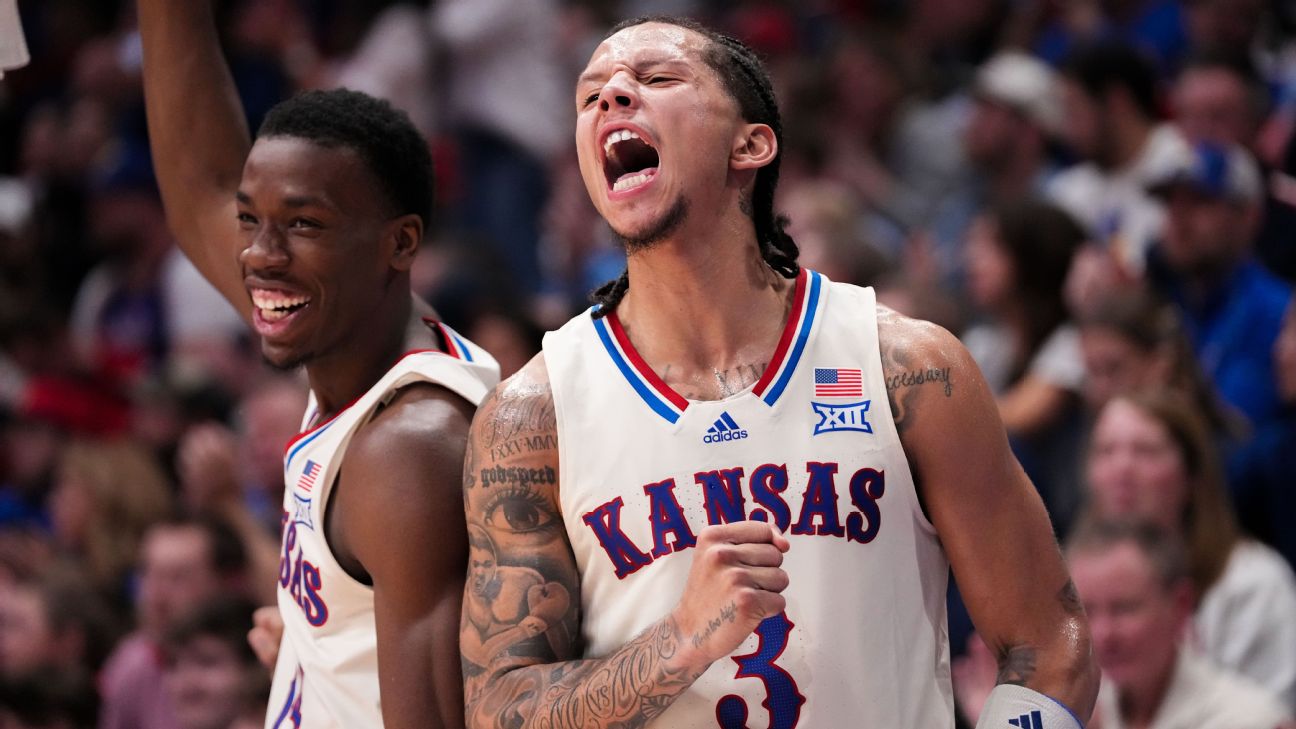
- ▪Kansas and Houston lead the Big 12 through superior systemic continuity rather than high-variance portal roster overhauls.
- ▪Kansas operates at an elite 124.7 offensive rating and an 81.8 defensive rating under Bill Self.
- ▪Houston maintains a suffocating defensive identity backed by a 125.7 offensive efficiency mark under Kelvin Sampson.
- ▪Early futures market pricing undervalues the stability of these two rosters relative to experimental conference rivals.
Tyran Stokes sliced through Kentucky's perimeter defense, dropping 23 points in an 89-69 masterclass at the United Center that proved the five-star freshman's arrival in Lawrence has completely altered the Big 12 landscape. Bill Self's squad executed with surgical precision, establishing an elite offensive pace that left the Champions Classic field scrambling for answers.
While rival conference programs scrambled to piece together rotations through the erratic transfer portal, Kansas and Kelvin Sampson's Houston Cougars demonstrated the unmatched power of institutional continuity. Armed with suffocating defensive schemes and veteran cores, these two heavyweights have carved out a commanding early-season tier that separates them from the rest of the conference's high-variance contenders.
The Tyran Stokes Effect: Why the Champions Classic Was 'Personal'
Growing up just hours away in Louisville, Kentucky, freshman sensation Tyran Stokes treated Tuesday night's primetime showdown like a personal referendum on his basketball lineage. His dominant 23-point display powered Kansas to a blistering 89-69 rout, anchoring an offense operating at a 62.2% effective field goal percentage (eFG% measuring field goal efficiency while giving extra weight to three-pointers).
Bill Self has masterfully blended elite five-star talent with returning veteran leadership, creating an active rotation featuring standouts like Tre White and Taylen Kinney that minimizes early-season mistakes. By posting a stingy defensive efficiency rating (DRTG measuring points allowed per 100 possessions) of 81.8, the Jayhawks prove they are far more than just a high-flying scoring machine.
 15Kansas Jayhawks(3-0)VS.
 8Houston Cougars(2-0)15Kansas73.08Houston71.615Kansas124.78Houston125.715Kansas62.2%8Houston57.2%15Kansas37.1%8Houston36.7%
Houston’s Rim Protection: The Mathematical Edge in Big 12 Play
On the other side of the conference ledger, Kelvin Sampson’s Houston Cougars are quietly constructing another defensive masterclass anchored by suffocating ball pressure and disciplined interior walls. Holding opponents to just 61.5 points per game, the Cougars boast a stifling DRTG of 85.9 that completely neutralizes uncohesive, portal-heavy offenses struggling to find spatial rhythm.
Houston's signature defensive identity relies on forcing live-ball turnovers—averaging 12.5 steals per game—while maintaining a robust 57.2% eFG% on the offensive end. This mathematical edge in shot quality and turnover margin establishes a towering barrier for new conference arrivals attempting to match their grueling physical standards.
| TEAM | REC | STANDING | PPG | ORTG | EFG% | 3PT% | AST/TO |
|---|---|---|---|---|---|---|---|
| 15Kansas Jayhawks | 3-0 | 1st in Big 12 | 91.0 (#62) | 124.7 (#62) | 62.2% | 37.1% | 1.4 |
| 8Houston Cougars | 2-0 | 1st in Big 12 | 90.0 (#73) | 125.7 (#73) | 57.2% | 36.7% | 1.8 |
Market Mispricing: Continuity vs. Portal Volatility
Betting markets are still adjusting to the profound volatility generated by programs relying on four or more incoming transfers to construct entirely new rotations. Historical November trends heavily favor rosters returning over sixty percent of their minutes, a threshold both Kansas and Houston easily clear as they anchor the top of the Big 12 standings at 3-0 and 2-0, respectively.
Fading uncohesive portal teams during early conference play has become a sharp bettor's dream, especially when evaluating futures odds for conference crowns. The implied probability baked into Kansas and Houston's current prices accurately reflects a two-tier hierarchy where elite coaching continuity consistently outperforms raw talent accumulation.
Path to the Final Four: Navigating the Big 12 Gauntlet
Kansas kicked off its brutal schedule with a statement 1-0 mark against top-twenty-five competition, validating a 91.0 points-per-game scoring average that ranks among the nation's elite tier. Bill Self's squad combines blistering pace—playing at 73.0 possessions per forty minutes—with calculated half-court execution that leaves opponents gasping for air.
Meanwhile, Houston's projected win totals in a fiercely balanced Big 12 remain exceptionally high, supported by an estimated offensive efficiency of 125.7 points per 100 possessions. Current Final Four futures prices on both programs offer immense compounding value for disciplined bettors who prioritize defensive floor efficiency over seasonal roster experiments.
Capitalizing on Continuity: Why Kansas and Houston Dominate the Big 12 Futures Market
The modern college basketball transfer portal has turned early-season roster construction into an experimental laboratory for most programs, but Kansas and Houston offer a stark counter-narrative built entirely on systemic continuity. While rival Big 12 contenders grapple with chemistry issues stemming from massive roster overhauls, the Jayhawks and Cougars rely on established foundational schemes under Hall of Fame leadership.
Evaluating the underlying efficiency metrics reveals a clear two-tier separation within the conference. Kansas boasts an elite offensive efficiency rating of 124.7 points per 100 possessions paired with an 81.8 defensive rating, while Houston counters with an identical blueprint anchored by high-pressure defense and a 125.7 offensive rating. This synchronized execution minimizes early-season variance.
Bettors should look past short-term volatility and target these two powerhouses in the conference futures market before the broader public catches on to the structural flaws of newly assembled portal-heavy rosters. Lock in position value early while prices still reflect minor early-season line adjustments.
Frequently Asked Questions
Sharp Wire Market DeskWhat makes Kansas and Houston different from other Big 12 teams this season?
Both programs rely on deep systemic continuity and established coaching cultures under Bill Self and Kelvin Sampson, successfully avoiding the chemistry friction seen in portal-heavy rosters.
How do the efficiency metrics support backing Kansas and Houston in futures markets?
Kansas operates with an elite 124.7 offensive rating and an 81.8 defensive rating, while Houston counters with a 125.7 offensive efficiency mark, creating a clear two-tier statistical gap in the conference.
Why is early futures positioning recommended for these two teams?
As newly assembled rosters across the Big 12 continue to struggle with spacing and ball security, the market value on Kansas at +2800 and Houston at +2500 will likely shorten.
