









































































































Cooper Flagg’s 43-Point Surge Powers the 7-4 Dallas Mavericks
At 7-4 behind teenage phenom Cooper Flagg, steady closer Kyrie Irving, and Dusty May’s egalitarian motion attack, the Dallas Mavericks are turning a roster reset into real Western Conference staying power.
 Dallas Mavericks Odds & Splits →
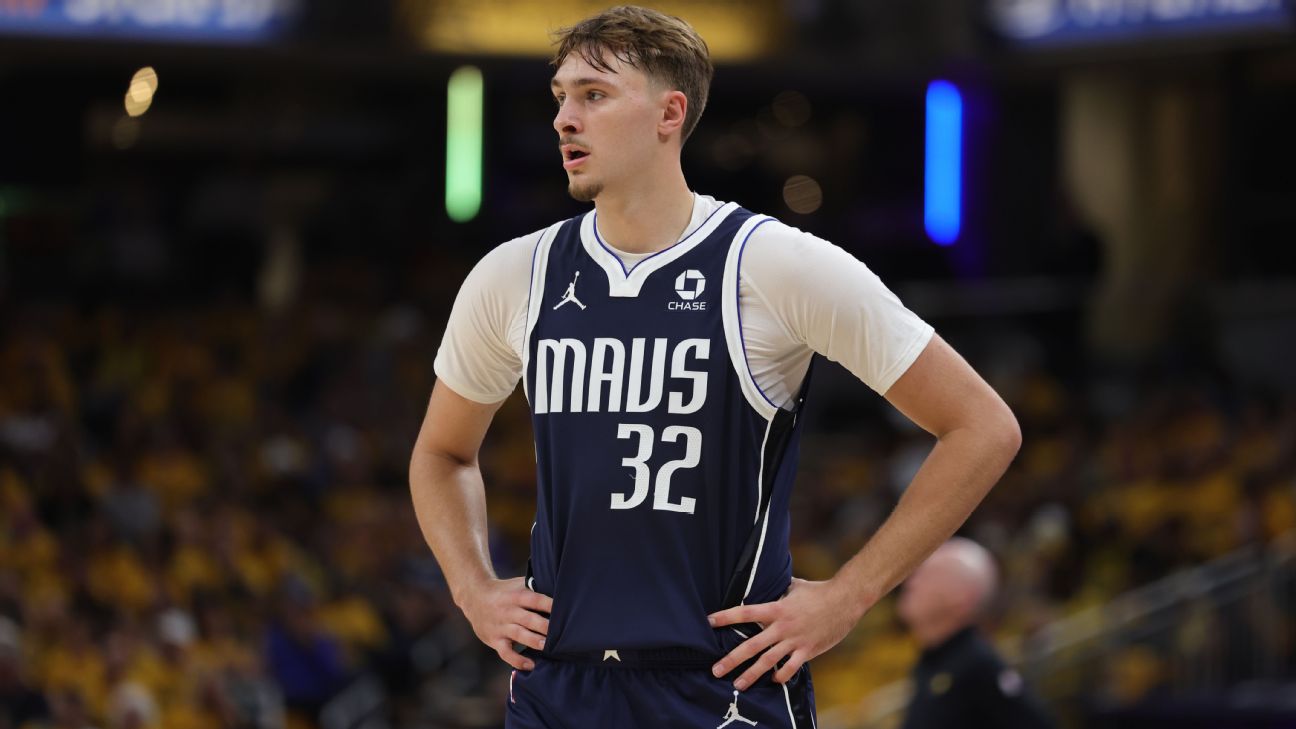
- ▪Cooper Flagg’s 43-point, 10-rebound outing and Kyrie Irving’s 35 points against Indiana lifted Dusty May’s Dallas Mavericks to 7-4.
- ▪Promoting Caleb Martin into the starting five alongside Irving, Flagg, P.J. Washington, and Daniel Gafford stabilized perimeter defense while shifting Max Christie to bench duties.
- ▪Dallas ranks 9th in the NBA in ORTG (118.0), 10th in DRTG (113.2), 4th in two-point accuracy (57.0%), and 7th in rebound rate (53.0%) despite Dereck Lively II’s ongoing foot rehab.
- ▪Oddsmakers still price Dallas at +20000 in 2027 NBA Championship futures despite a +4.8 net efficiency profile through 11 games.
Midway through the fourth quarter Monday night in Dallas, 19-year-old forward Cooper Flagg absorbed chest-to-chest contact in the lane, rose cleanly over Indiana’s rotating frontline, and buried another feathery jumper on his way to a career-defining 43 points, 10 rebounds, six assists, three steals, and a block. Beside him, Kyrie Irving completed his first back-to-back set of the campaign with 35 points as the Dallas Mavericks rallied past the Pacers 125-122 to reach 7-4.
Just twenty-four hours earlier, Flagg had carved up Brooklyn for 25 points and a career-best 12 assists in a 130-93 home rout—his third straight double-double—right after he and Irving shook off a sluggish opening half to beat Utah 112-100 in Friday’s NBA Cup group action. What looked on paper in October like a patient developmental bridge year in a cutthroat Southwest Division has rapidly evolved into one of November’s most balanced two-way surges.
Dusty May’s Motion Blueprint Outpaces Summer Transition Expectations
Entering the 2026-27 campaign after handing the clipboard to head coach Dusty May and turning the page on the prior era following former franchise centerpiece Luka Doncic’s trade to the Lakers and former wing Klay Thompson’s departure, outside expectations framed Dallas as a long-term construction project. Navigating the Southwest Division at 7-4—even while sitting fourth behind blistering early paces from division rivals—proves May’s collegiate reputation for adaptable, five-out ball movement translates seamlessly to NBA spacing and half-court shot creation.
Irving has openly credited May’s unselfish offensive structure and clear defensive accountability for why this reshaped locker room is stacking early wins against both playoff veterans and rebuilding squads. Rather than relying on static late-clock isolation every trip down the floor, Dallas operates at a crisp 97.4 pace factor and ranks eighth across the NBA with 290 total assists (26.4 per game). May warned in training camp that with so many playable wings and guards, nobody would feel fully satisfied with their minute allotment, yet that internal competition has fueled relentless second-half energy.
Caleb Martin’s Promotion and Cooper Flagg’s Point-Forward Gravity
May’s boldest early-season adjustment arrived when he shifted guard Max Christie to the second unit and elevated rugged veteran Caleb Martin into the starting backcourt beside Irving, Flagg, P.J. Washington, and center Daniel Gafford. Moving Christie off the opening five was less an indictment of his perimeter shooting than a structural play to fortify point-of-attack physicality from the opening tip while giving the second unit balanced floor spacing alongside guard Marcus Sasser and young forward Zaccharie Risacher.
That starting alignment allows Irving to toggle effortlessly between primary initiator and lethal off-ball relocator while Flagg operates as a 6-foot-9 connective hub from the elbows, nail, and short corners. Washington’s switchable strength at power forward and Gafford’s vertical lob threat force opposing help defenders into impossible choices whenever Flagg attacks downhill. Behind them, Naji Marshall, Santi Aldama, Jett Howard, Walter Clayton Jr., Tobi Lawal, and Moussa Cisse give May interchangeable length to survive back-to-back sets without sacrificing defensive versatility.
Dallas Mavericks(7-4)VS.NBA League AvgMavericks97.4Mavericks118Mavericks54.8%Mavericks34.4%Top-Ten Two-Way Efficiency Meets Interior Force Under the Hood
Beneath the 7-4 surface, the league-wide analytical profile confirms Dallas is one of the NBA’s few genuine top-10 two-way units. Averaging 114.9 points per game while holding opponents to 110.3, the Mavericks rank ninth in the NBA with an ORTG (offensive rating, points scored per 100 possessions) of 118.0 and 10th in the NBA with a DRTG (defensive rating, points allowed per 100 possessions) of 113.2 for a +4.8 net efficiency margin. Dallas sits eighth league-wide in eFG% (effective field-goal percentage, which weights three-pointers for their extra value) at 54.8% and ninth in TS% (true shooting percentage, accounting for twos, threes, and free throws) at 58.4%.
Why Beating the Closing Number Matters More Than Last Night's Final Score.
How Vegas oddsmakers hang opening numbers, why closing line value (CLV) is the best indicator of long-term winning play, and how to calculate the vig on any market.
Even while shooting a mid-pack 34.4% from beyond the arc (17th in the NBA) on a 40.8% 3PAr (three-point attempt rate) and 78.2% at the foul line (14th), Dallas bludgeons defenses inside, converting 57.0% of its two-point tries (fourth in the NBA) to rank eighth league-wide with 538 points in the paint alongside 183 fast-break points. Second-chance physicality and active hands seal the math: the Mavericks post a 31.7% offensive rebound rate (12.5 offensive boards per game), rank seventh in the NBA in total rebound rate (53.0%), and sit sixth league-wide in both steals (96, or 8.7 per game) and blocks (62, or 5.6 per game). The main blemishes are live-ball giveaways (a 14.2% turnover rate, 1.7 assist-to-turnover ratio) and whistle trouble, ranking seventh-highest in the NBA with 247 personal fouls.
Surviving Dereck Lively II’s Foot Rehab Through Frontcourt Next-Man-Up Grit
Dallas has stacked those top-eight rebounding and paint numbers despite missing a vital interior pillar in 22-year-old center Dereck Lively II, who remains out week-to-week rehabbing a foot injury with no immediate return date locked in beyond upcoming November check-ins. With Lively sidelined, starting center Daniel Gafford has anchored the restricted area admirably while athletic reserve Moussa Cisse and stretch big Santi Aldama absorb crucial backup five minutes to protect the rim and finish dump-off passes.
Frontcourt attrition was tested further on Monday when depth forward Morez Johnson Jr. sat out the second leg of the back-to-back with leg soreness—currently listed as questionable—after grabbing nine rebounds in 19 productive minutes Sunday against Brooklyn. Meanwhile, rookie forwards Sergio de Larrea (out week-to-week with a right knee strain) and Tarik Biberovic (out with right heel inflammation that has delayed his NBA debut) remain unavailable. May’s willingness to trust Cisse’s rim protection and Marshall’s small-ball toughness has kept Dallas’s 10th-ranked defense intact.
Rest-of-Season Trajectory Across a Loaded Western Conference Gauntlet
The immediate measuring stick arrives Thursday night at Target Center against an 8-3 Minnesota Timberwolves squad that ranks third in the NBA in defensive efficiency. Cleaning up the 15.4 player turnovers and 22.5 personal fouls per game will determine whether Dallas can consistently beat elite half-court defenses on the road when transition run-outs dry up and every late-clock possession demands crisp execution.
Still, the foundational pieces for a sustainable 2027 Western Conference postseason push are unmistakably in place before Thanksgiving. Flagg is already authoring 40-point two-way masterclasses before his 20th birthday—fueled, amusingly enough, by his viral mid-game peanut-butter-and-jelly routine—Irving looks completely rejuvenated in May’s egalitarian system, and the eventual return of Lively’s vertical spacing and rim deterrence will only elevate a frontcourt already punishing opponents on the glass.
Evaluating Dallas’s +20000 Championship Price Against Top-Ten Two-Way Efficiency
Oddsmakers continue to price the Dallas Mavericks like a lottery developmental roster, hanging +20000 odds on the 2027 NBA Championship futures board—an implied probability of roughly 0.50%. That deep-longshot tag reflects justified respect for Western Conference heavyweights and Dallas’s youth in high-leverage spring series, yet it lags noticeably behind a 7-4 team ranking ninth in ORTG (118.0) and 10th in DRTG (113.2).
With Thursday’s road test in Minnesota still awaiting official opening numbers on the game board, futures and division watchers should track Dallas’s turnover and foul discipline over the next two weeks. If Dusty May’s group trims its 14.2% turnover rate before Dereck Lively II returns to bolster the center rotation, this +20000 championship ticket holds clear upward re-pricing potential.
Frequently Asked Questions
Sharp Wire Market DeskWho is coaching and starting for the Dallas Mavericks in 2026-27?
Head coach Dusty May leads a 7-4 Dallas Mavericks squad featuring a confirmed starting five of Kyrie Irving, Caleb Martin, Cooper Flagg, P.J. Washington, and Daniel Gafford.
What is Dereck Lively II’s injury status for the Dallas Mavericks?
Center Dereck Lively II remains out week-to-week while rehabbing a foot injury, leaving Daniel Gafford, Moussa Cisse, and Santi Aldama to cover the center rotation.
What are the Dallas Mavericks’ 2027 NBA Championship odds?
Oddsmakers currently list the Dallas Mavericks at +20000 to win the 2027 NBA Finals, carrying an implied championship probability of 0.50%.
