






































































































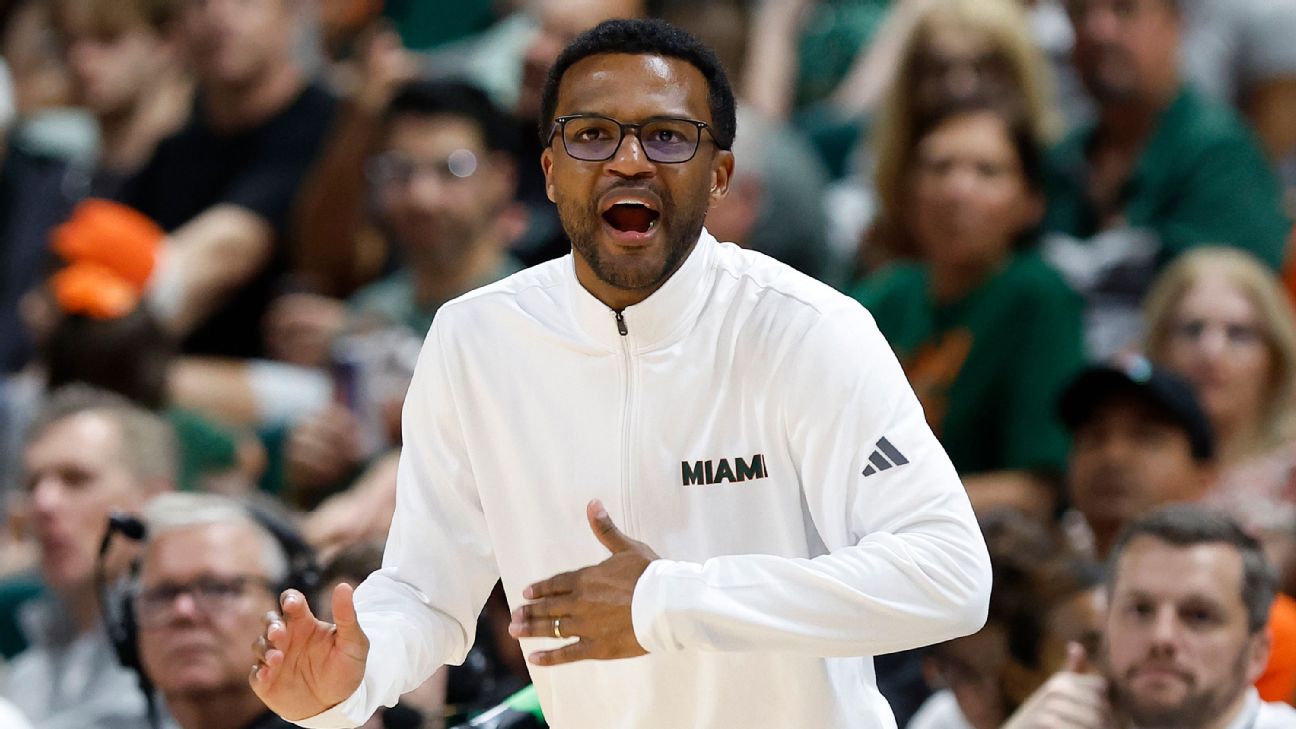
Jai Lucas Rebuilds Miami Around Relentless Glass Control and Grit
After testing top-ranked Florida in Tampa, Jai Lucas’s No. 17 Hurricanes have leaned on Malik Reneau, Shelton Henderson, Acaden Lewis, and 45.7 rebounds per game to establish a bruising ACC identity.
 Miami Hurricanes Odds & Splits →
- ▪Head coach Jai Lucas’s No. 17 Miami Hurricanes (2-1) bounced back from a competitive 77-67 neutral-site loss against No. 1 Florida by routing Wagner (83-57) and North Florida (89-51).
- ▪Sophomore guard Acaden Lewis (24 pts vs. Florida, 8 ast vs. UNF), senior forward Malik Reneau (16 pts vs. UNF), and sophomore Shelton Henderson (19 pts vs. Wagner) headline a balanced attack.
- ▪Miami dominates the glass at 45.7 rebounds per game (14.3 offensive) and converts 55.1% inside the arc, leaving massive offensive upside once its 4.7 made threes per game climb.
- ▪Upcoming tests against TCU in Las Vegas (Nov 24) and No. 18 Alabama in Coral Gables (Dec 2) will gauge Miami’s readiness for the 18-team ACC race.
Ten minutes into Monday night’s homestand inside Coral Gables’ Watsco Center, senior forward Malik Reneau sealed his defender deep beneath the basket, took an entry feed in stride, and powered home another contested layup as North Florida’s interior defense buckled. Reneau’s 16 points, paired with 14 from physical sophomore forward Shelton Henderson and eight assists from sophomore point guard Acaden Lewis, propelled No. 17 Miami to a ruthless 89-51 rout.
Combined with Friday’s 83-57 thrashing of Wagner, head coach Jai Lucas has engineered an emphatic two-game response after his Hurricanes opened the 2026-27 season with a competitive 77-67 neutral-site setback against top-ranked Florida in Tampa. Now sitting 2-1 and averaging a dominant 45.7 rebounds per contest while holding opponents to 61.7 points per night, Miami has unveiled a rugged, defense-first blueprint built to trade blows atop the eighteen-team ACC.
Malik Reneau, Shelton Henderson, and Somto Cyril Impose Frontcourt Will
Gone are the undersized, finesse-oriented Miami lineups of years past; Jai Lucas has constructed an intimidating frontcourt rotation packed with grown-man strength and length. At 6-foot-9 and 235 pounds, senior lefty Malik Reneau gives the Hurricanes a go-to low-post hub, while 6-foot-6, 240-pound sophomore wing-forward Shelton Henderson plays like a wrecking ball—grabbing nine rebounds against No. 1 Florida, pouring in 19 points with five assists against Wagner, and adding 14 points against North Florida.
Behind that duo, Lucas rotates waves of size: 6-foot-11, 260-pound junior center Somto Cyril, 6-foot-10 junior forward Robert Miller III (eight boards Monday), 6-foot-8 freshman Caleb Gaskins, 6-foot-7 junior Marcus Allen, 6-foot-8 junior DeSean Goode, and 6-foot-11 senior Egor Ryzhov. That collective bulk explains why Miami has hauled down 137 rebounds across three games—45.7 per contest, including 14.3 offensive rebounds per night—erasing defensive misses before opponents can push transition pace and punishing smaller lineups with relentless second-chance tip-ins around the cylinder.
Acaden Lewis’s Dynamic Creation Anchors a Deep Perimeter Rotation
Even against defending juggernaut No. 1 Florida (+650 national title odds) in the Tampa opener, sophomore guard Acaden Lewis proved he can score and facilitate against elite length. The 6-foot-2 playmaker dropped 24 points to keep Miami within striking distance of the Gators before showcasing his poised court vision with eight assists in Monday’s 38-point blowout of North Florida, routinely hitting bigs in stride on rim runs.
Lucas flanks Lewis with stout perimeter defenders in 6-foot-4, 220-pound sophomore Dante Allen, 6-foot-2 junior L.J. Cason, 6-foot-7 senior wing Nick Dorn, and veteran seniors Brent Bland and Quin Berger. Averaging 14.0 assists against 12.0 turnovers (1.2 assist-to-turnover ratio) while committing only 16.0 personal fouls per game, Miami’s guards apply physical on-ball pressure over perimeter screens without gifting opponents cheap trips to the foul line.
17Miami Hurricanes(2-1)VS.D-I Top-100 Avg17Miami73.317Miami108.717Miami48.3%17Miami22.2%Solving the 3-Point Freeze Is Miami’s Clear Offensive Unlock
Inspect Miami’s 79.7 points per game through three contests and one stark split jumps off the stat sheet: elite paint finishing paired with ice-cold perimeter shooting. Inside the arc, the Hurricanes are converting an impressive 55.1 percent of their two-point attempts (76-of-138) and knocking down 72.6 percent at the free-throw line (15.0 makes on 20.7 attempts per game). Beyond the three-point stripe, however, Miami has connected on just 14-of-63 attempts—4.7 triples per game at a frigid 22.2 percent clip.
Only the Sports You Bet. None of the Filler.
Pick NFL, NBA, College Hoops, College Football, NHL, UFC, or Soccer. You only get the morning notes and line moves for the leagues you actually follow.
That early three-point slump drags overall field-goal percentage to 44.8 percent, shooting efficiency—which adjusts field-goal percentage for three-point value—down to 0.48, and scoring efficiency—points scored per field-goal attempt—to 1.189. The silver lining is obvious: if Dorn, Lewis, Bland, and Cason lift Miami’s perimeter accuracy even into the mid-30s via inside-out kick-outs, opposing defenses will no longer be able to pack the paint against Reneau and Henderson.
Coral Gables Tune-Ups Set Up TCU in Vegas and Ranked Alabama
Miami’s November schedule gives Lucas three straight home dates at Watsco Center—against North Alabama on November 13, Rider on November 17, and Manhattan on November 20—to iron out half-court spacing and generate clean catch-and-shoot rhythm from deep while rotating ten players comfortably. Building crisp offensive flow now is essential before the Hurricanes board a flight west for Feast Week.
On November 24, Miami meets physical Big 12 opponent TCU on a neutral floor inside Las Vegas’s T-Mobile Arena, followed on December 2 by a blockbuster ACC-SEC showdown hosting No. 18 Alabama (+4500 title odds) in Coral Gables. Testing Miami’s 61.7-point scoring defense and 45.7-rebound physicality against Alabama’s 102.0-point perimeter barrage will serve as one of December’s most fascinating stylistic clashes anywhere in college basketball.
ACC Contention Landscape and 2027 NCAA Tournament Verdict
Surveying the early eighteen-team ACC race reveals plenty of opportunity behind powerhouse No. 2 Duke (+485 national title favorite) and unbeaten No. 6 Virginia (4-0, +2800), alongside 3-0 starts from Virginia Tech (+2800), North Carolina (+6600), No. 10 Louisville, NC State (+25000), SMU (+30000), and Pittsburgh (+30000). Having already gone toe-to-toe with No. 1 Florida for forty minutes on a neutral court, No. 17 Miami clearly belongs in the conference’s upper tier.
Rebounding and interior defense rarely slump on the road in January and February 2027, giving Jai Lucas an enviable baseline as conference play approaches. Once Miami’s perimeter shooters regress positively from their 4.7 made threes per game and trim early half-court turnovers, this deep, physically imposing Hurricane roster has the muscle to lock down a top-four ACC seed and threaten second-weekend upsets in the 2027 NCAA Tournament.
Glass Dominance and Defense Signal Under-Totals & ACC Value
With no live single-game line posted yet ahead of Friday’s home matchup against North Alabama—and Miami sitting outside the top-five national title favorites led by ACC rival Duke (+485) and opener foe Florida (+650)—sharp handicappers should evaluate Coral Gables through its conference peers and game-total profile. In an eighteen-team ACC market pricing No. 6 Virginia and Virginia Tech at +2800 and North Carolina at +6600, No. 17 Miami’s elite interior physicality and veteran frontcourt depth stand out immediately.
Through three games—including holding top-ranked Florida to 77 points on a neutral floor in Tampa before limiting Wagner and North Florida to 57 and 51 at Watsco Center—Jai Lucas’s defense yields just 61.7 points per night while dominating the boards at 45.7 rebounds per game (14.3 offensive). Until oddsmakers fully adjust totals downward for Miami’s deliberate two-point shot diet (138 two-point tries versus 63 threes), disciplined 16.0 foul rate, and suffocating defensive rebounding control, Hurricanes full-game unders and ACC regular-season placements merit serious attention.
Frequently Asked Questions
Sharp Wire Market DeskWho is the head coach of the Miami Hurricanes in 2026-27?
Jai Lucas leads No. 17 Miami (2-1), building a physical, rebounding-driven ACC contender anchored by Malik Reneau, Shelton Henderson, Acaden Lewis, and Somto Cyril.
How has Miami performed through its first three games of the 2026-27 season?
After dropping a hard-fought 77-67 neutral-site opener to top-ranked Florida in Tampa, the Hurricanes dominated Wagner 83-57 and North Florida 89-51 at Watsco Center.
What statistical strength defines Miami’s early 2026-27 profile?
Miami’s frontcourt length fuels 45.7 total rebounds and 14.3 offensive boards per game alongside 55.1% two-point shooting and a stingy 61.7 points allowed per contest.
