












































































































Relentless Forechecking and Logan Stankoven's Finishing Surge Power the 14-3 Carolina Hurricanes
Rod Brind'Amour's remodeled forward rotation leads the NHL in scoring and shot volume as the Carolina Hurricanes pace the Metropolitan Division ahead of their trip to Finland.
 Carolina Hurricanes Odds & Splits →
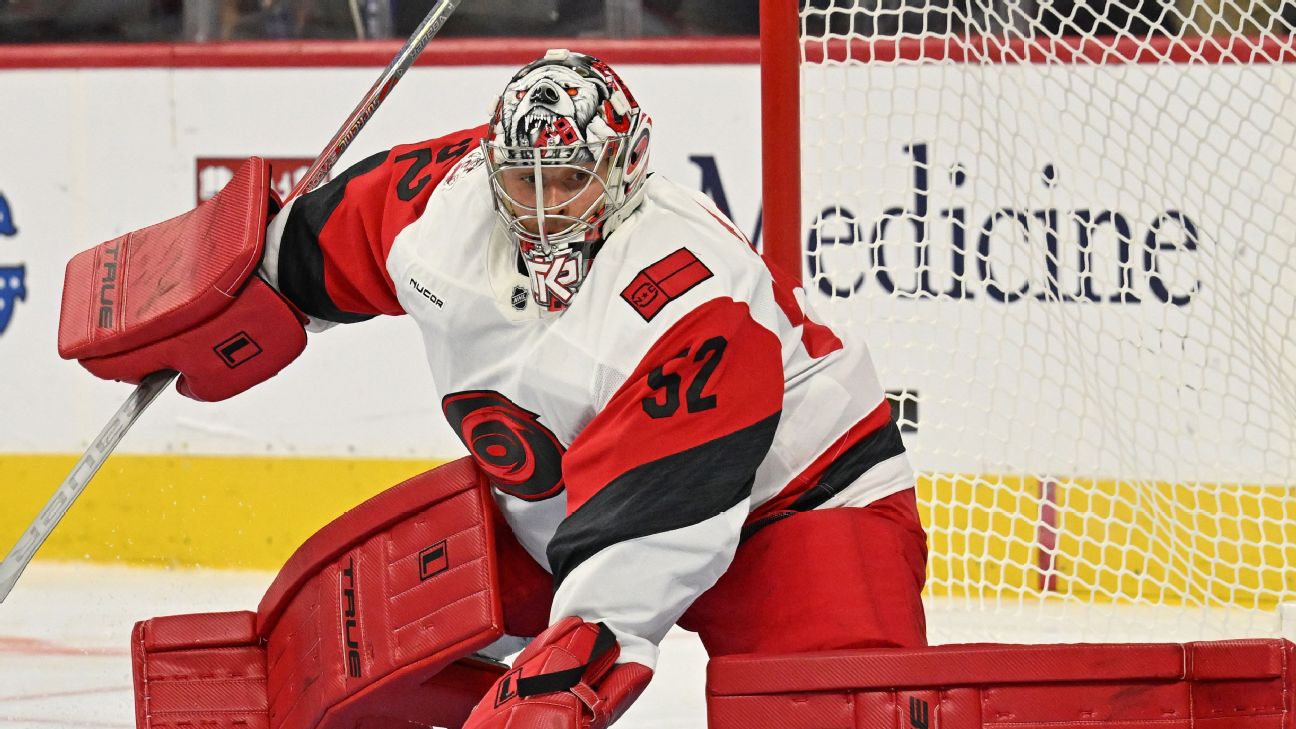
- ▪Rod Brind'Amour's 14-3 Carolina Hurricanes pace the Metropolitan Division with an NHL-best 4.11 goals per game, 2.32 GAA, and +35 goal differential.
- ▪Sebastian Aho (26 points) and team goal leader Logan Stankoven (11 goals) headline a deep four-line attack bolstered by Nikolaj Ehlers and Taylor Hall.
- ▪Carolina's 59.7% shot share (33.3 shots for vs. 22.4 against) insulates the roster even if its elevated 102.2 5v5 PDO experiences mild finishing regression.
- ▪Jordan Staal remains on injured reserve (calf, eligible Dec. 3) while William Carrier is questionable (knee) entering Thursday's game against Seattle.
Before the visitors could even sort out defensive-zone coverage on Saturday night, Jordan Martinook buried two first-period strikes, Andrei Svechnikov hammered home a pair of his own, and the Carolina Hurricanes detonated the Chicago Blackhawks in a 9-2 rout. Watching four waves of forecheckers pin tired defenders below the goal line shift after shift felt less like an early-November regular-season tilt and more like an inescapable conditioning test inside Lenovo Center.
Nineteen appearances into the 2026-27 campaign, Rod Brind'Amour's club commands first place in the Metropolitan Division at 14-3, boasting a league-best +35 goal differential, 78 goals, and 134 team assists. Long stereotyped as a high-volume outfit that labored to convert grade-A looks into easy tallies, Raleigh's retooled lineup has married suffocating territorial pressure with ruthless finishing efficiency ahead of Thursday's overseas clash against the Seattle Kraken at Veikkaus Arena.
Championship Urgency Meets a Dominant 14-3 Metropolitan Division Pace
Perennial regular-season excellence has never been the question in Raleigh, yet entering autumn, skeptics wondered whether integrating multiple new top-nine forwards and reconfiguring the second defense pair would cause early turbulence. Instead, Brind'Amour's detail-obsessed culture absorbed every newcomer without dropping a beat. Thursday night's gritty 5-3 divisional victory over the New York Islanders—sealed when William Carrier broke a third-period deadlock—followed by Saturday's seven-goal demolition of Chicago underscored just how many ways this roster can win.
Across the NHL, nobody has matched Carolina's ability to dictate terms from the opening puck drop. The Hurricanes rank first league-wide in first-period shots on goal (200), first in second-period shots (232), and second in third-period shots (196), piling up 632 total shots on net. Rather than coasting on reputation, Brind'Amour demands relentless backpressure from every forward trio, turning neutral-zone regroups into instant counterattacks before opposing defensemen can set their gaps. That relentless skating pressure has also drawn 63 power-play opportunities—tied for seventh most in the league—forcing backpedaling opponents into hooking and holding infractions just to survive defensive-zone shifts.
Nikolaj Ehlers, K'Andre Miller, and the Remodeled Four-Line Attack
Carolina's summer blueprint centered on injecting dynamic rush speed and interior finishing touch around franchise center Sebastian Aho, whose 16 assists and 26 points pace the club. Flanking Aho with Andrei Svechnikov and heavy forechecker William Carrier on the top unit has freed Brind'Amour to unleash an electric second trio featuring Nikolaj Ehlers, emerging center Logan Stankoven, and creative right wing Jackson Blake. Stankoven leads the roster with 11 goals, thriving off Ehlers' zone-entry speed to attack soft seams between the circles.
Depth scoring no longer evaporates when the top six steps off the ice, because veterans Taylor Hall and Mark Jankowski skate alongside play-driver Seth Jarvis on the third line while Eric Robinson, Jesperi Kotkaniemi, and Martinook form a punishing fourth unit. On the back end, pairing rangy newcomer K'Andre Miller with Sean Walker behind top shutdown tandem Jaccob Slavin and Jalen Chatfield—plus sheltering offensive blueliner Shayne Gostisbehere next to physical newcomer Alexander Nikishin—gives Pyotr Kochetkov (.920 save percentage) elite protection in front of the crease.
Carolina Hurricanes(14-3)VS.NHL League AvgHurricanes.899Hurricanes2.32Hurricanes59.7%Hurricanes22.2% (15th)Inside a 59.7 Percent Five-on-Five Shot Share and 107.2 Special Teams Index
Under the analytical hood, Carolina's five-on-five (5v5, standard even-strength play) territorial profile borders on absurd. The Hurricanes control 59.7 percent of shot attempts on target, firing 33.3 shots per game while starving opponents to an NHL-low 22.4 shots against per night for a league-leading +206 shot differential. That relentless puck pursuit fuels 4.11 goals per game (first in the NHL) against a stingy 2.32 goals-against average (fourth), backed by an NHL-high 90 takeaways that offset 319 giveaways created by constant offensive-zone possession. Because Carolina spends so much of each evening cycling inside the offensive zone, opposing shooters have forced just 316 even-strength saves all season (26th in the NHL), keeping Kochetkov's workload remarkably clean between high-leverage bursts.
Why Beating the Closing Number Matters More Than Last Night's Final Score.
How Vegas oddsmakers hang opening numbers, why closing line value (CLV) is the best indicator of long-term winning play, and how to calculate the vig on any market.
One caution light flickers in Carolina's 102.2 PDO—a metric combining even-strength shooting percentage and save percentage that gravitates toward 100.0 over a full season. Shooting 12.3 percent (10th in the league) suggests modest finishing regression will eventually cool this 4.11-goal scoring clip, though Kochetkov's personal .920 save percentage outpaces a .899 team mark (tied for ninth). Meanwhile, a 107.2 percent Special Teams Net Index (power-play conversion plus penalty-kill rate) provides massive leverage: a 22.2 percent power play (15th) pairs with an 85.0 percent penalty kill (seventh) that has potted three shorthanded tallies while allowing zero shorthanded goals against.
Navigating Jordan Staal's Absence and William Carrier's Day-to-Day Status
What makes Carolina's 14-3 sprint even more impressive is that Brind'Amour has engineered top-seven penalty killing and 50.2 percent faceoff efficiency (15th in the NHL) with defensive conscience Jordan Staal sidelined on injured reserve. Staal is nursing a calf injury and is not eligible for activation until December 3, removing the franchise's premier matchup center from heavy defensive-zone draws and late-game lead protection.
Rather than overloading Aho with exhausting checking assignments, Brind'Amour has leaned on Kotkaniemi and Jankowski to absorb tough defensive starts while backup netminder Brandon Bussi spells Kochetkov to keep the starter fresh. Top-line left wing William Carrier also carries a questionable tag with a day-to-day knee issue (estimated return November 12), meaning Robinson, Hall, or physical reserve Nicolas Deslauriers can slide seamlessly up the left side if Carrier needs extra rest during Thursday's European showcase against Seattle.
Metropolitan Gauntlet Trajectory Toward the 2027 Stanley Cup Playoffs
Banking 14 victories before mid-November gives Carolina an enviable cushion atop a competitive Metropolitan Division where New Jersey (13-6), the New York Rangers (10-8), and Washington (10-6) are all banking early standings points. Even if Carolina's 102.2 PDO cools toward neutral 100.0 territory over the winter grind, outshooting opponents by nearly 11 shots per contest insulates this group from prolonged losing skids. Maintaining zero empty-net goals allowed and limiting overtime losses to just two across 19 contests underscores how clinical Brind'Amour's bench management remains whenever Carolina carries a lead into the third period.
Once Staal returns in December to restore four-deep center physicality and Nikishin logs another two months acclimating to North American ice angles alongside Gostisbehere, Raleigh's roster will boast arguably its most balanced postseason profile of the Brind'Amour tenure. Thursday's neutral-site test against the Kraken at Veikkaus Arena launches the next phase of a campaign built squarely for a deep run in the 2027 Stanley Cup Playoffs.
Evaluating Carolina's +650 Stanley Cup Price Against Elite Underlying Process
Oddsmakers price the Carolina Hurricanes at +650 to capture the 2027 Stanley Cup, carrying a 13.33 percent raw implied championship probability at the top tier of the NHL futures board. While buying a club sitting on a 14-3 record and a 102.2 PDO normally invites peak-market tax, Carolina's underlying 59.7 percent shot share and league-best +206 shot differential confirm that this dominance is structural rather than a mirage.
With no single-game market posted yet ahead of Thursday's international matchup against the Seattle Kraken, disciplined futures positioning comes down to monitoring how Carolina's 22.2 percent power play and Kochetkov's .920 save percentage travel across winter divisional clashes. Because Raleigh has already banked a commanding points buffer in the Metropolitan Division without Jordan Staal, +650 remains a justifiable anchor piece in a balanced 2027 championship portfolio.
Frequently Asked Questions
Sharp Wire Market DeskWhat are the Carolina Hurricanes' 2027 Stanley Cup odds right now?
Oddsmakers currently list the Carolina Hurricanes at +650 to win the 2027 Stanley Cup, reflecting a 13.33% raw implied probability as they sit 14-3 atop the Metropolitan Division.
Who leads the Carolina Hurricanes in scoring during the 2026-27 season?
Sebastian Aho leads Carolina with 16 assists and 26 points, while second-line center Logan Stankoven paces the Hurricanes with 11 goals and Pyotr Kochetkov owns a .920 save percentage.
When is Jordan Staal eligible to return for the Carolina Hurricanes?
Veteran center Jordan Staal is on injured reserve with a calf injury and is eligible to return on December 3, while winger William Carrier is questionable with a day-to-day knee issue.
