











































































































Robert Wright III and Three-Point Barrages Fuel No. 23 BYU’s Charge
Averaging 100.0 points per game behind junior guard Robert Wright III and a scorching 45.8 percent clip from beyond the arc, Kevin Young’s 3-0 Cougars look built to trade offensive haymakers atop the 16-team Big 12.
 BYU Cougars Odds & Splits →
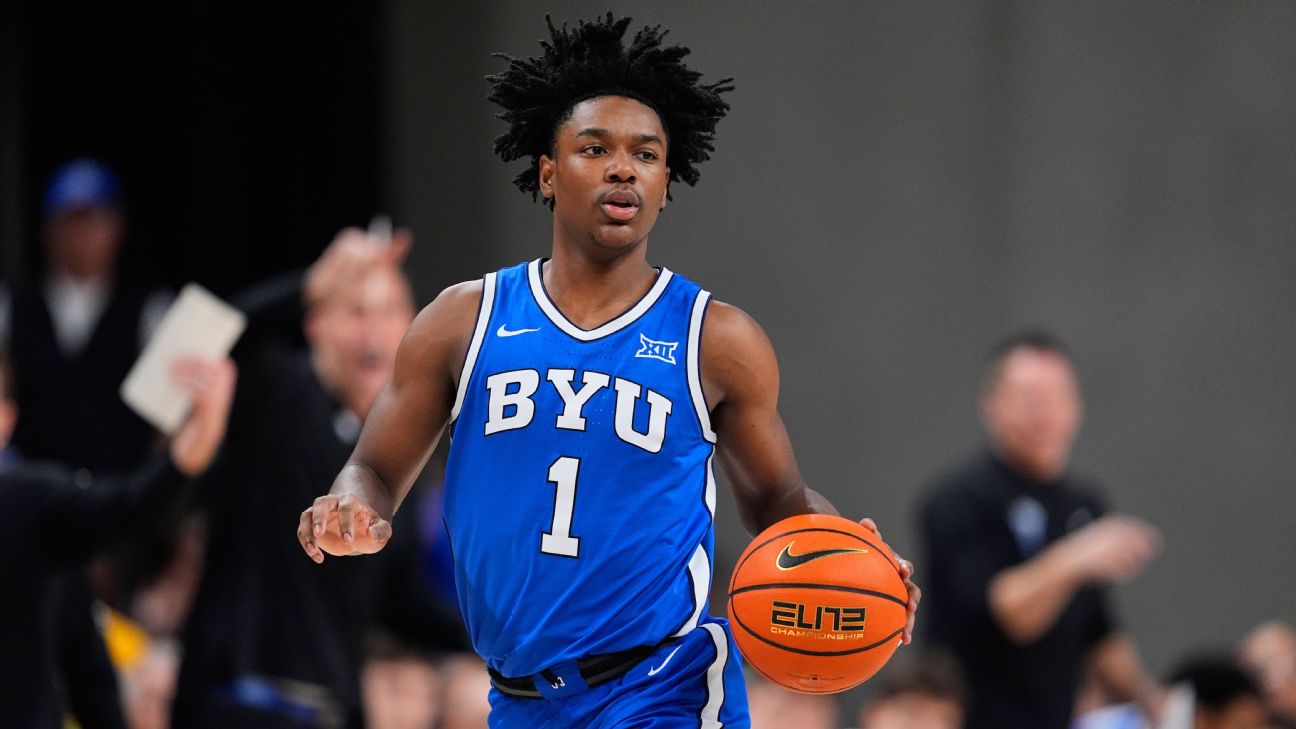
- ▪Junior guard Robert Wright III has powered No. 23 BYU’s 3-0 start with 75 total points (25.0 PPG), highlighted by 35 points in a 94-83 win over Ohio State and 21 points with six assists against Queens.
- ▪Head coach Kevin Young’s five-out offense averages 100.0 points per game on 54.7% overall shooting and 45.8% from deep—including 17 made threes against Queens—backed by a 1.9 assist-to-turnover ratio.
- ▪Frontcourt depth featuring Jaxon Kohler, Khadim Mboup, Tyler Betsey, Adam Stewart, and 7-foot-1 freshman Petar Ostojic anchors 38.3 rebounds and 4.7 blocks per game.
- ▪Oddsmakers price BYU at +7500 in 2027 national championship futures ahead of upcoming non-conference tests against Montana State (Nov. 13), Washington in Maui (Nov. 23), and Northwestern (Dec. 5).
Midway through the second half inside the Marriott Center in Provo, junior point guard Robert Wright III snaked around a high ball screen, drew two Queens defenders toward the free-throw line, and whipped a skip pass to the weak-side wing for BYU’s 17th three-pointer of the night. By the final buzzer of that 98-82 victory, head coach Kevin Young’s offense had turned another forty-minute track meet into a clinic in modern floor spacing.
Through three games of the 2026-27 campaign, No. 23 BYU sits at 3-0 with a +68 cumulative point differential and an eye-popping 100.0 points per contest. Paired with a season-opening 94-83 neutral-court triumph over Ohio State at Salt Lake City’s Delta Center and a 108-67 demolition of Omaha, Young’s up-tempo five-out blueprint has immediately positioned the Cougars as one of the Big 12’s most combustible offensive threats.
Robert Wright III Takes Command of Kevin Young’s Pro-Style Attack
Every five-out offensive system requires a fearless primary creator who can collapse paint coverage without coughing up live-ball turnovers, and the 6-foot-1, 183-pound Wright has seized that mantle from opening night. Against Big Ten foe Ohio State at the Delta Center, Wright erupted for 35 points and five assists to pace BYU’s 94-83 statement win. He followed that outburst with an effortless 19 points in the 41-point rout of Omaha before tallying 21 points and six assists against Queens, giving him 75 points across his first three outings—a blistering 25.0-point scoring average.
What elevates Wright’s early surge beyond raw scoring volume is how cleanly he orchestrates Young’s early-clock reads alongside 6-foot-6 junior guard Collin Chandler and senior guard Nate Pickens. BYU is dishing 18.0 assists against just 9.3 turnovers per game, producing a 1.9 assist-to-turnover ratio—a foundational playmaking metric that divides total assists by giveaways to measure ball security under pressure. When Chandler, who handed out five assists against Omaha, shares secondary initiation duties, opposing backcourts cannot simply blitz Wright at half-court without surrendering wide-open rhythm triples.
Unsustainable Heater or Structural Spacing? Examining the 45.8% Arc Clip
Draining 45.8 percent from three-point range and 54.7 percent from the floor across three games naturally invites skepticism about shooting variance, yet the geometry of BYU’s shot diet suggests sustainable half-court efficiency. Rather than settling for contested step-backs late in the shot clock, Young’s spacing stretches opposing bigs twenty-five feet from the basket, opening wide driving lanes and inside-out kickouts. Knocking down 17 triples against Queens was the byproduct of relentless paint touches and crisp extra-pass discipline from wings like senior Dawson Baker and 6-foot-9 junior forward Tyler Betsey.
Even when BYU’s perimeter percentages cool toward a realistic high-30s baseline against Big 12 length, the Cougars possess the size to punish switches on the interior. Senior forward Jaxon Kohler (6-foot-10, 245 pounds) pulled down eight rebounds against Queens, junior forward Khadim Mboup (6-foot-10) grabbed eight boards versus Omaha, and Betsey led the glass with seven rebounds in the win over Ohio State. Supported by 6-foot-10 senior Jake Wahlin, 6-foot-11 junior center Adam Stewart, and 7-foot-1 freshman Petar Ostojic, BYU owns a 38.3 rebounds-per-game foundation and 74.2 percent free-throw shooting.
23BYU Cougars(3-0)VS.D-I Top-100 Avg23BYU70.623BYU141.623BYU66.1%23BYU45.8%Perimeter Containment Questions Before Maui and Big 12 Play
If there is an early blemish on Provo’s 3-0 resume, it sits on the defensive side of the ledger, where BYU has surrendered 77.3 points per game (232 total points allowed). Yielding 83 points to Ohio State and 82 points to Queens underscores how high-possession tempo—more total trips up and down the hardwood—inevitably inflates raw opponent scoring totals, even when a team wins comfortably. Still, Young’s staff knows that trading baskets at an 80-point clip becomes far more treacherous once Big 12 play tips off in January 2027.
Subscribe to Our Free Morning Betting Newsletter.
See which lines moved overnight before you place a bet—verified sharp money moves, key injury news, and daily edges delivered to your inbox every morning.
Encouragingly, BYU’s length on the wings provides the raw athletic tools to tighten half-court containment over the coming weeks. With 6-foot-7 junior Brody Kozlowski alongside talented 6-foot-8 freshmen Bruce Branch III and Dean Rueckert, and 6-foot-6 freshman Dovydas Buika providing versatility, the Cougars are averaging 6.0 steals and 4.7 blocked shots per contest. Turning Stewart, Ostojic, and Kohler into consistent vertical rim deterrents without fouling will determine whether BYU can string together consecutive stops when perimeter jumpers rim out on the road.
Non-Conference Gauntlet From Lahaina to the Delta Center
Before entering the 16-team Big 12 cauldron—where unbeaten Baylor (3-0, +107 point differential), TCU (3-0, +99), No. 15 Kansas (3-0, +94), No. 16 Texas Tech (3-0, +58), and No. 8 Houston (2-0, +57) have all flexed early muscle—BYU faces a carefully calibrated November and December runway. The Cougars return to the Marriott Center floor against Montana State on November 13 and Northern Colorado on November 19, two tune-ups designed to sharpen bench rotations and defensive communication.
The true non-conference litmus tests arrive right before Thanksgiving and in early December. On November 23, BYU travels to the Lahaina Civic Center in Maui to battle unbeaten Big Ten opponent Washington (2-0), followed by a December 5 neutral-site clash against undefeated Northwestern (3-0) back at Salt Lake City’s Delta Center and an in-state showdown hosting Utah State at the Marriott Center on December 10. Stacking Quad 1 and neutral-floor victories across those three dates would insulate BYU’s resume well ahead of March 2027.
2026-27 Big 12 Contention Ceiling and Tournament Verdict
Competing inside a Big 12 hierarchy headlined by No. 8 Houston, No. 15 Kansas, No. 12 Arizona, No. 16 Texas Tech, Baylor, and Iowa State leaves minimal margin for defensive lapses, yet BYU’s offensive ceiling rivals nearly anyone in the conference. Very few college backcourts can match the speed-and-size pairing of Wright and Chandler, and even fewer rosters feature six rotation forwards standing 6-foot-8 or taller who are comfortable operating in space.
If Young’s rotation trims half-court defensive breakdowns against Washington in Maui and Northwestern in Salt Lake City, No. 23 BYU has the firepower to secure a top-five finish in the Big 12 standings and a protected seed in the 2027 NCAA Tournament. In single-elimination March 2027 settings, a guard averaging 25.0 points surrounded by 45.8 percent perimeter marksmen is the exact archetype capable of blowing up a regional bracket.
Elite Five-Out Spacing Creates Upside on BYU’s +7500 Championship Price
With no live head-to-head single-game spread currently posted prior to the Montana State tip-off, market evaluation on No. 23 BYU centers squarely on the 2027 national championship futures board, where oddsmakers list the Cougars at +7500—carrying an implied title probability of just 1.32 percent, calculated by dividing 100 by 7,600. Inside the Big 12, that +7500 tag trails Houston (+2500), Texas Tech (+2700), Kansas (+2800), Arizona (+2000), and Iowa State (+5500), yet sits ahead of fellow 3-0 league unbeaten Baylor (+10000).
Teams combining a dominant lead guard like Robert Wright III (25.0 PPG), a 1.9 assist-to-turnover ratio, and elite three-point volume historically punch above their seed line in tournament play. Rather than chasing inflated home numbers during mid-major tune-ups, disciplined bettors should treat +7500 as a small-stake upside position ahead of BYU’s neutral-floor tests against Washington on November 23 and Northwestern on December 5, where another statement win will compress Provo’s outright number.
Frequently Asked Questions
Sharp Wire Market DeskWho is the head coach and leading scorer for the 2026-27 BYU Cougars?
Kevin Young leads No. 23 BYU in 2026-27, and junior guard Robert Wright III paces the Cougars at 25.0 points per game through a 3-0 start after scoring 35 against Ohio State, 19 against Omaha, and 21 against Queens.
What are BYU’s 2027 NCAA Championship odds?
Oddsmakers currently list the 3-0 BYU Cougars at +7500 to win the 2027 national championship.
Which key non-conference games are next on BYU’s 2026-27 schedule?
After hosting Montana State (Nov. 13) and Northern Colorado (Nov. 19) at the Marriott Center, BYU faces Washington in Maui on November 23, Northwestern at the Delta Center on December 5, and Utah State on December 10.
