














Sticker Shock in Indy: Why the Colts' Asking Price for Jonathan Taylor Changes the Math
As trade deadline rumors swirl around Indianapolis, the hefty price tag for star running back Jonathan Taylor is forcing contenders to re-evaluate their roster-building strategies. We examine how front-office valuations impact team power ratings and this weekend's matchup against Dallas.
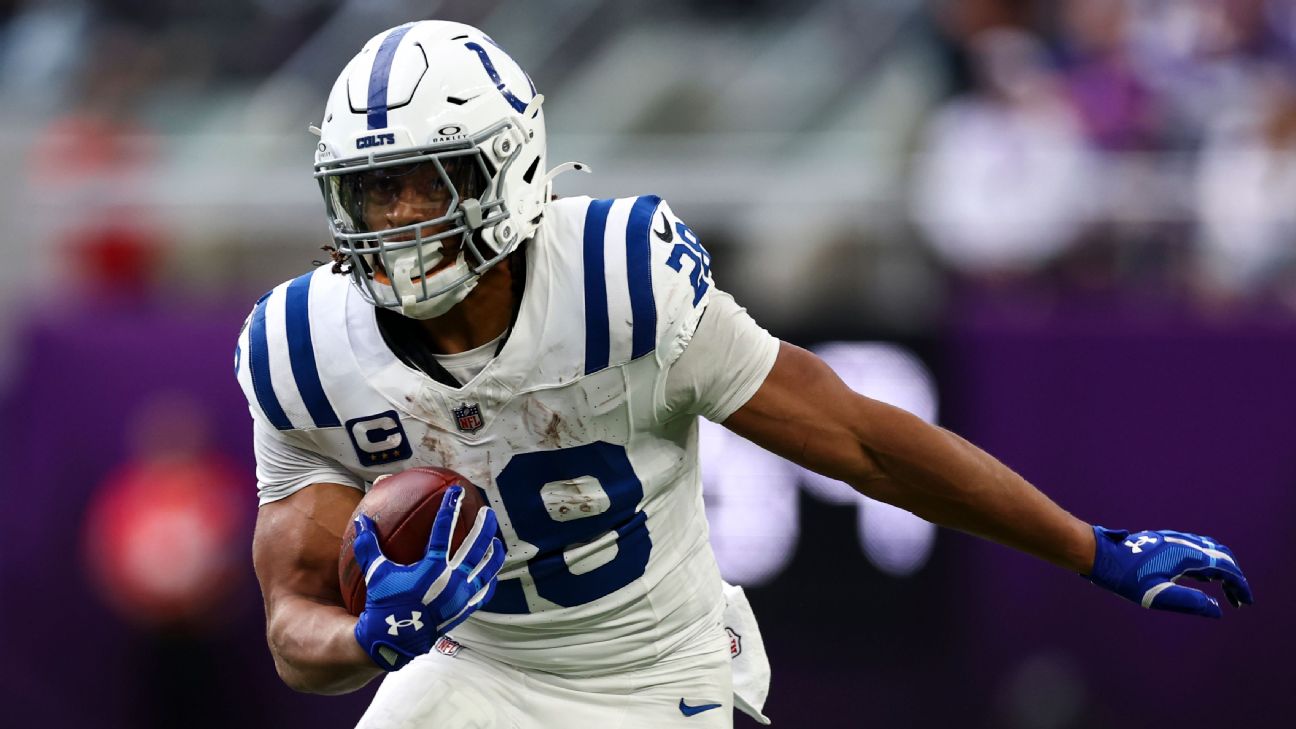
- ▪The Indianapolis Colts have set a first-round pick or a Christian McCaffrey-level package as their baseline asking price for Jonathan Taylor.
- ▪Indianapolis enters this week's matchup ranked 31st in yards per pass attempt (5.7) and 25th in completion percentage (60.7%).
- ▪The betting market lists the Dallas Cowboys as 5.5-point favorites at Lucas Oil Stadium with an over/under of 51.5 points.
Trade deadline rumor mills operate on a spectrum between speculative fan fiction and verified league intelligence, but the recent reporting surrounding the Indianapolis Colts' asking price for star running back Jonathan Taylor falls squarely into the latter category. When front offices set a baseline demand that mirrors the multi-pick package the San Francisco 49ers once surrendered for Christian McCaffrey—or an outright first-round selection—the entire landscape of buyer-seller dynamics shifts instantly. For a franchise navigating a 2-6 record and searching for long-term roster capital, placing such a premium valuation on an elite offensive weapon is entirely rational. Yet, it simultaneously creates a formidable economic barrier for prospective contenders looking to add explosive backfield production before the stretch run of the season.
This organizational posture directly influences how the betting market perceives the Colts as they prepare to host the Dallas Cowboys at Lucas Oil Stadium. Vegas oddsmakers currently have the spread posted with the Dallas Cowboys -5.5 (-110) / Indianapolis Colts +5.5 (-110) *(lines courtesy of YouWager.lv)* under a total of Over 51.5 (-110) / Under 51.5 (-110). While trade speculation rarely alters immediate game-day execution directly, it provides sharp analysts with a clear window into organizational intent. When a front office holds firm on exorbitant trade compensation, it signals a refusal to sell low on premier talent, preferring to retain foundational assets unless an overpay materializes. That stubborn valuation standard trickles down into how power raters price Indianapolis's ceiling relative to opponents who feature healthier roster depth and more dynamic perimeter weaponry.
To understand why the Colts' offensive ecosystem faces such steep uphill climbs against disciplined defensive units, one must examine the trench and perimeter metrics that dictate weekly outcomes. Indianapolis currently posts a 60.7 completion percentage, ranking 25th across the league, alongside a meager 5.7 yards per pass attempt that ties for 31st overall. These aren't random anomalies; they reflect a passing attack that struggles to generate explosive gains downfield, yielding a yards-per-reception average of just 9.5 which sits 29th in the NFL. When opposing defensive coordinators map out their coverage shells against Indianapolis, they routinely crowd the intermediate zones, daring the Colts' wide receivers and tight ends to beat single-man coverage on the outside without sustaining consistent vertical threats.
The deficiency in the aerial game places an immense burden on the ground attack, making the swirling trade rumors around Jonathan Taylor all the more critical to the franchise's identity. Although the Colts manage 116.5 rushing yards per game—good for 16th in the league—and generate a respectable 4.1 yards per carry, the absence of an efficient passing game allows opponents to load the box with seven or eight defenders on early downs. PFF grading illustrates this structural imbalance clearly: while Indianapolis earns a solid 74.2 grade in the run game, its overall pass offense lags behind at a sub-replacement 54.3 composite mark. Without reliable vertical stretches from wideouts or consistent separation against man coverage, opposing secondaries can easily bracket primary targets and force checkdowns.
Examining the protection numbers further exposes the mechanical friction within the Indianapolis scheme. The offensive line has surrendered 23 total sacks, tied for the second-most in the NFL, resulting in 153 yards lost and a net passing yards average of just 174.6 per contest (28th in the league). Interestingly, this protection unit flashes elite moments on a 0-100 PFF scale, boasting a stellar 92.7 pass-protection grade that proves the blockers frequently establish clean pockets. The breakdown occurs not purely at the line of scrimmage, but in the time it takes for perimeter receivers to uncover against tighter coverage shells. When quarterbacks are forced to hold the ball waiting for slow-developing routes to break open, even top-tier blocking metrics degrade into coverage sacks.
How to Spot Reverse Line Movement When the Public Is All Over One Side.
When 75% of the tickets are on a popular favorite and the spread still moves the other way, respected money is stepping in. Here is how to tell real steam from a head-fake.
 Dallas Cowboys
 Indianapolis Colts
Defensively, the Colts encounter similar schematic hurdles that explain their current standing in the American Football Conference. The pass rush has generated 16 sacks (tied for 19th) and 25 tackles for loss (31st), while the coverage unit struggles with a 54.3 PFF grade. Opposing signal-callers routinely exploit soft spots in zone coverages, capitalizing on quick three-step drops to neutralize the Colts' interior push. Against a Dallas offense that boasts diverse receiving options and high-tempo route concepts, defensive coordinator Gus Bradley will need his secondary to minimize explosive plays and prevent receivers from operating freely across the middle of the field.
As kickoff approaches inside the climate-controlled confines of Lucas Oil Stadium—where weather is a non-factor—market movement reflects minor adjustments to the opening numbers. The point spread has remained anchored at Dallas -5.5 while the juice on the underdog Indianapolis side experienced a slight tick from -115 to -110, signaling balanced two-way action from syndicate players. No-vig fair win probability calculations price the Cowboys at approximately 67.9% (fair moneyline around -212) compared to the Colts at 32.1% (fair moneyline near +212), keeping the theoretical book hold tight at 3.92%. Bettors eyeing the total of 51.5 must weigh whether both offenses can sustain drives or if red-zone stalling will push the final score toward the under.
