











































































































































Ducks vs. Avalanche Preview: MacKinnon Injury Shifts Odds and Betting Value
With Nathan MacKinnon sidelined, the Colorado Avalanche face a massive efficiency void, opening a high-value window for the Anaheim Ducks at Ball Arena.
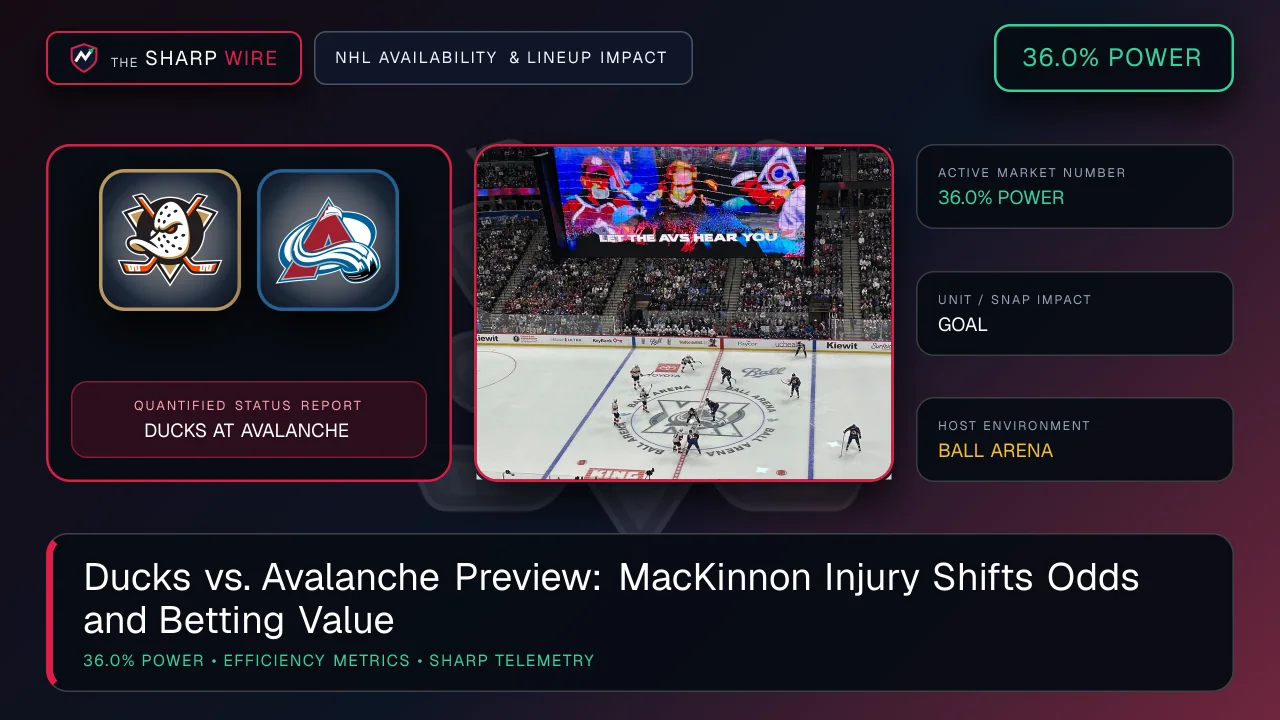
- ▪The Colorado Avalanche face a significant offensive regression risk without Nathan MacKinnon, who leads the team with 30 points.
- ▪Anaheim Ducks goaltender Lukas Dostal will need to stabilize a defense that ranks 30th in goals against per game to secure the upset against the Colorado Avalanche.
- ▪The Anaheim Ducks' elite special teams leverage, combined with a 14.9% shooting percentage, creates a viable path to victory against the Colorado Avalanche in Denver.
The Colorado Avalanche face a daunting reality at Ball Arena as they prepare to navigate the next several weeks without Tier 1 star Nathan MacKinnon, who is sidelined with a lower-body injury until December 12. This absence fundamentally reshapes the Central Division landscape, forcing head coach Jared Bednar to reconfigure an offensive engine that currently ranks tied for third in the NHL with 4.05 goals per game.
For the visiting Anaheim Ducks, who arrive in Denver looking to stabilize their own defensive metrics, the news offers a distinct tactical opening. Under the guidance of head coach Joel Quenneville, the Ducks must leverage their elite special teams—currently operating at a 110.7% net index, defined as the sum of power play and penalty kill percentages—to exploit a Colorado roster suddenly lacking its primary transition catalyst and top-line playmaker.
MacKinnon's Absence and the Avalanche Efficiency Void
The loss of Nathan MacKinnon removes 30 points of offensive production from the Avalanche lineup, a void that will test the depth of the Central Division contenders. Colorado currently maintains a 5v5 PDO of 102.7, a metric measuring the sum of shooting percentage and save percentage that serves as a proxy for puck luck; any figure above 101.4 typically signals an unsustainable heater. Without MacKinnon’s ability to drive high-danger chances, the Avalanche will likely see this efficiency regress as they lean on Brock Nelson and Nazem Kadri to maintain their 52.5% Corsi proxy, which tracks the percentage of total shots taken by the team versus their opponents.
Defensively, the Avalanche must now rely more heavily on goaltender Mackenzie Blackwood to mask gaps in transition. While Colorado’s power play has been effective at a 23.9% clip, the loss of their primary playmaker forces a shift in scheme. The team’s ability to sustain its 8th-ranked shot differential of 61.0 will depend on whether the remaining top-six forwards can replicate the zone-entry dominance that MacKinnon provided. With the team’s current 13.4% shooting percentage, the margin for error is razor-thin as they adjust to a new hierarchy on the ice.
Altitude, Fatigue, and the Honda Center vs. Ball Arena Contrast
The unique venue physics of Ball Arena, situated at an elevation of 5,280 feet, present a significant challenge for the Anaheim Ducks. The thin air is known to accelerate fatigue for visiting defensemen, particularly during the third period when defensive rotations are most critical. Anaheim’s defensive structure under Joel Quenneville has struggled with consistency, currently allowing 3.86 goals against per game, which ranks 30th in the NHL. To neutralize the altitude, the Ducks must prioritize puck possession and minimize the long, grinding shifts that exacerbate the physical toll of playing in Denver.

Goaltender Lukas Dostal will be the focal point for the Ducks as they look to stifle a Colorado offense that is searching for its new identity. Dostal must contend with a Colorado attack that, despite the injury, remains dangerous in home-ice conditions. Anaheim’s defensive core, including Jackson LaCombe and Drew Helleson, will need to execute clean breakouts to avoid the high-pressure environment that Ball Arena fosters. If the Ducks can maintain their disciplined structure, they have the potential to exploit the fatigue that often plagues home teams in the final frame.
Market Verdict: Why the Ducks Offer Value at +125
The betting market has remained largely static following the announcement of MacKinnon’s injury, with the Colorado Avalanche holding steady at -1.5 (+175) on the puck line and the Anaheim Ducks sitting at +125 on the moneyline. This pricing reflects a lingering respect for the Avalanche’s depth, yet it ignores the significant efficiency void created by the absence of their franchise center. The market’s refusal to adjust the line suggests that the current odds may be overvaluing Colorado’s historical performance while underestimating the immediate impact of losing a Tier 1 star.
For those analyzing the matchup, the value lies in the discrepancy between Colorado’s implied team total of 4.0 goals and their projected offensive output without MacKinnon. The Ducks, who boast an elite special teams leverage index and a 14.9% shooting percentage—the second-highest in the league—are well-positioned to capitalize on any defensive lapses from the home side. With the moneyline holding at +125, the Ducks represent a high-value opportunity to secure a win against a team currently undergoing a major tactical transition.
Ducks vs. Avalanche Preview: MacKinnon Injury Shifts Odds and Betting Value
The absence of Nathan MacKinnon due to a lower-body injury creates a massive void in the Colorado Avalanche's offensive structure. Without their primary engine, the Colorado Avalanche's ability to dictate play at Ball Arena is significantly compromised, providing a clear opening for the Anaheim Ducks to capitalize on the thin air of Denver.
The Anaheim Ducks enter this matchup with elite special teams, currently boasting the league's top power play at 36.0%. Against a Colorado Avalanche squad that will be forced to adjust its entire top-six rotation, the Anaheim Ducks' ability to capitalize on man-advantage opportunities makes them a high-value underdog play at the current +125 moneyline.
Frequently Asked Questions
Sharp Wire Market DeskWhat is the impact of Nathan MacKinnon's injury on the Colorado Avalanche?
Nathan MacKinnon's absence removes the Colorado Avalanche's primary offensive engine, forcing a reshuffle of the top-six forward lines and reducing their overall scoring ceiling.
How do the Anaheim Ducks' special teams compare to the Colorado Avalanche?
The Anaheim Ducks currently lead the NHL with a 36.0% power play, while the Colorado Avalanche operate at 23.9%, giving the Anaheim Ducks a distinct advantage in man-advantage situations.
What is the expected goaltender matchup for this game?
Lukas Dostal is the confirmed starter for the Anaheim Ducks, while Mackenzie Blackwood is slated to start in net for the Colorado Avalanche.