











































































































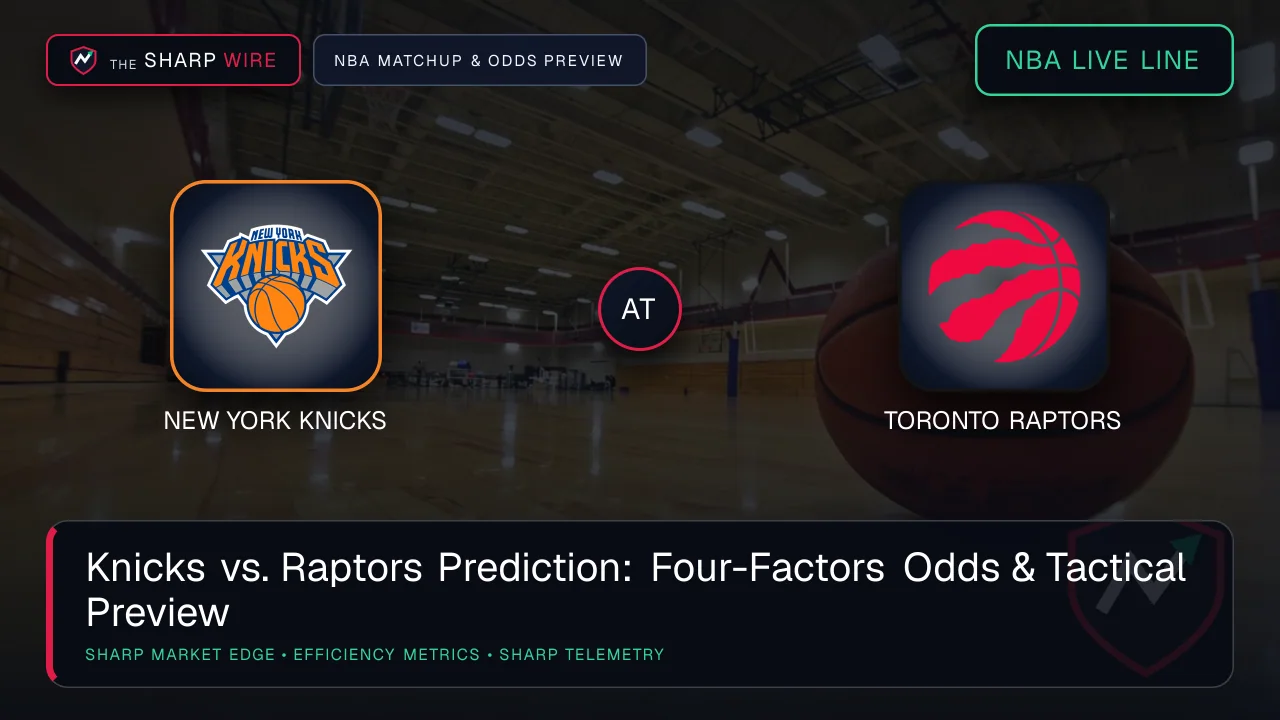
Knicks vs. Raptors Prediction: Four-Factors Odds & Tactical Preview
Following a narrow 112-108 result, the Knicks and Raptors meet again in Toronto. We break down the Four-Factors, pace adjustments, and rotation edges for this Atlantic Division rematch.
- ▪The New York Knicks maintain a top-tier offensive rebounding rate of 32.8%, which serves as the primary tactical counter to the Toronto Raptors' defensive rotation.
- ▪The Toronto Raptors' home-court performance at Scotiabank Arena remains a volatility factor, as they currently average 113.8 points per game despite a lower defensive efficiency rating.
- ▪With the spread holding steady at -3.5, the most disciplined approach is to wait for a move to the key number of 3 before committing to the New York Knicks.
Fresh off a 112-108 victory in Toronto, the New York Knicks and Toronto Raptors are set for an immediate rematch at Scotiabank Arena. Jalen Brunson’s late-game leadership and Karl-Anthony Towns’ presence in the paint provided the blueprint for the Knicks’ success, but the narrow margin suggests the Raptors are closer to a breakthrough than their 5-8 record indicates. With the market holding steady at the opening number of Knicks -3.5, the focus shifts to whether Toronto can adjust its defensive rotation to contain New York’s high-efficiency half-court execution.
The tactical chess match between Mike Brown and Darko Rajakovic hinges on controlling the game’s tempo and shot quality. While New York enters with a 7-6 record and a clear advantage in perimeter efficiency, Toronto’s ability to force turnovers and generate paint points remains a significant threat. As both teams prepare for the second leg of this back-to-back sequence in the same venue, the 216.5 total offers a baseline for how these two Atlantic Division rivals will navigate their respective offensive sets and defensive adjustments.
Four-Factors Efficiency: Knicks’ Offensive Precision
The New York Knicks maintain a high-efficiency offensive profile, anchored by strong ball movement and spacing. Their shot quality is defined by an effective field goal percentage (eFG%) of 51.9%, ranking 4th in the NBA, and a True Shooting percentage (TS%) of 55.7%, also 4th in the league. Jalen Brunson remains the primary engine for this rhythm, orchestrating half-court sets that prioritize spacing and high-percentage looks. Against a Toronto defense allowing 115.2 points per 100 possessions, the Knicks’ ability to maintain this shooting standard will be the primary indicator of their offensive ceiling.
Toronto’s defensive scheme must address the Knicks' interior efficiency, where New York ranks 2nd in the league with a 49.9% 2-point field goal percentage. While the Raptors have shown flashes of disruption, averaging 10.2 steals per game, their defensive rating reflects a struggle to consistently limit high-efficiency attempts. To force a regression in New York’s offensive output, Darko Rajakovic will need his wing defenders to minimize the open looks that allowed the Knicks to shoot 36% from beyond the arc in their previous meeting. The battle for shot quality remains the central tactical friction point.
 Knicks94.3
 Raptors97.9Knicks116.6Raptors116.2Knicks51.9%Raptors51.7%Knicks36.1%Raptors32.8%
Pace and Tempo: Controlling the 216.5 Total
The game’s tempo will be a critical variable in determining whether the 216.5 total is exceeded. The Toronto Raptors operate at a faster pace, averaging 97.9 possessions per 48 minutes, which ranks 3rd in the NBA. In contrast, the New York Knicks prefer a more measured approach, ranking 5th in the league with 94.3 possessions per 48 minutes. The previous 112-108 result demonstrated that even when the Knicks dictate a slower half-court game, the Raptors can push the pace to keep the scoring within reach.

With the total holding steady at 216.5, the game hinges on how many possessions are played in the half-court versus transition. New York’s ball security is a concern, as they rank 29th in turnover rate at 13.0%, which provides Toronto with the transition opportunities necessary to inflate the score. If the Knicks can value the basketball and force the Raptors into a grind-it-out half-court game, the total may lean toward the under. Conversely, if Toronto successfully turns defense into transition offense, the game is likely to push toward the higher end of the projected total.
Rotation Edges and Glass Leverage
Offensive rebounding remains a statistical equalizer for both teams, as they are among the league’s best at creating second-chance opportunities. The Toronto Raptors maintain an offensive rebound rate of 32.9%, while the New York Knicks follow closely at 32.8%, ranking 2nd. This glass leverage will likely dictate which team secures the extra possessions needed to cover the -3.5 spread. Karl-Anthony Towns, coming off a dominant performance on the glass, will be the focal point for New York’s effort to neutralize Toronto’s frontcourt intensity.
Immanuel Quickley’s role as the primary playmaker for Toronto is vital for the Raptors' rotation stability and ability to maintain offensive flow. His capacity to facilitate against New York’s defensive pressure will determine if Toronto can sustain its scoring efficiency throughout the full 48 minutes. Mike Brown’s adjustments for the road environment will likely focus on limiting the Raptors' ability to generate points in the paint, where Toronto ranks 1st in the league with 646 total points. Managing these rotation minutes will be the final piece of the tactical puzzle for both coaching staffs.
Knicks vs. Raptors: Tactical Efficiency and the Key-Number Wait
The current market at New York Knicks -3.5 and a total of 216.5 reflects an efficient assessment of this Atlantic Division rematch. While the New York Knicks hold a distinct edge in rebounding and half-court efficiency, the Toronto Raptors have shown resilience at Scotiabank Arena, consistently keeping games within a single-digit margin.
Given that the line has remained unchanged from the opening number, there is no immediate value in forcing a pregame position. The optimal strategy is to wait for the market to drift toward the key number of 3, providing a more favorable entry point on the New York Knicks, or to monitor live shot-quality metrics if the Toronto Raptors open with high-intensity defensive rotations.

Frequently Asked Questions
Sharp Wire Market DeskWhat is the tip-off time for the Knicks vs. Raptors game?
The game is scheduled to tip off at 7:30 PM ET on Tuesday, November 17, 2026.
Why is the current -3.5 spread considered efficient?
The -3.5 spread accurately reflects the New York Knicks' superior efficiency metrics while accounting for the home-court advantage held by the Toronto Raptors at Scotiabank Arena.
What is the key number to watch in this matchup?
The key number is 3, which represents the most common margin of victory in NBA games; waiting for the New York Knicks to reach this price provides a higher-probability entry point.