






























































































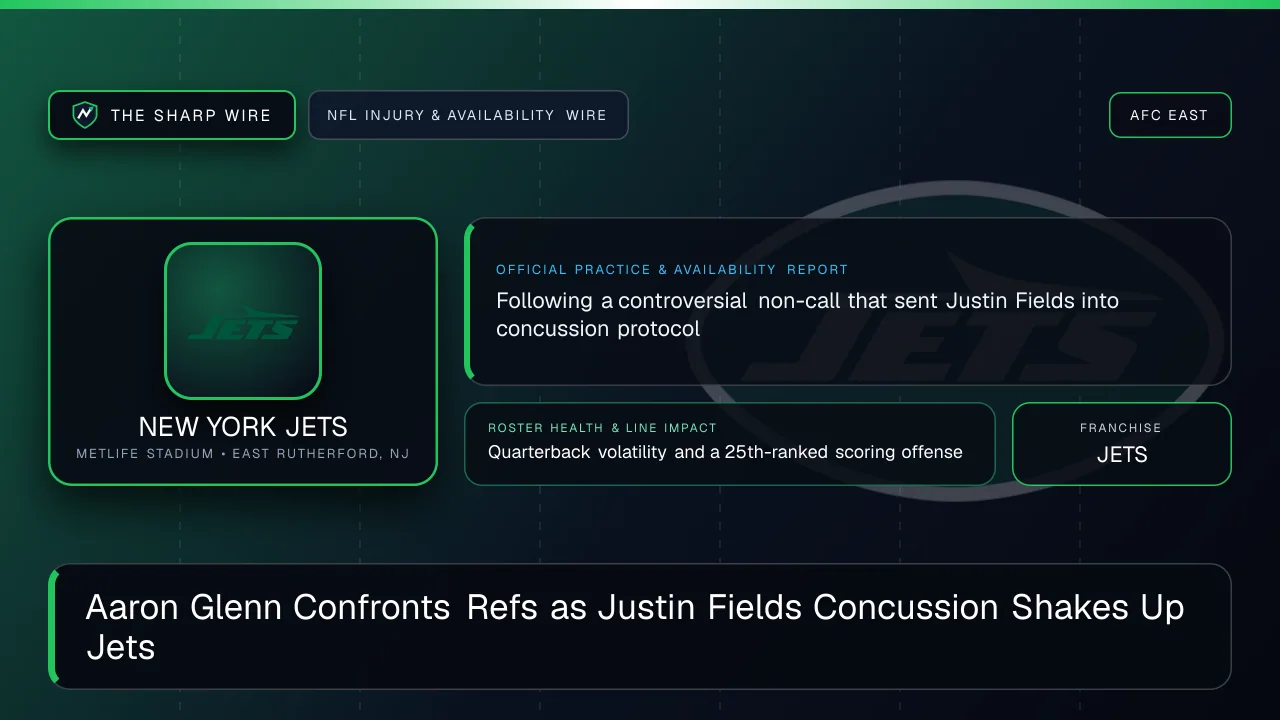
Aaron Glenn Confronts Refs as Justin Fields Concussion Shakes Up Jets
Following a controversial non-call that sent Justin Fields into concussion protocol, Jets coach Aaron Glenn's sideline frustration underscores a major turning point for New York's offense and market power rating.
 New York Jets Odds & Splits →
- ▪The New York Jets rank 25th in the NFL with 20.2 points per game, severely limiting offensive upside.
- ▪Pass protection remains a major liability with 28 sacks allowed, exposing backup quarterback depth.
- ▪Avoid longshot division futures like the New York Jets at +60000 in the AFC East.
Two defenders converged on Justin Fields just before halftime, crunching the New York Jets quarterback into the turf and sending him straight into concussion protocol without so much as a penalty flag for roughing the passer. That brutal, unpenalized helmet-to-helmet hit against the Buffalo Bills exposed an immediate vulnerability for an already struggling New York offense, triggering a furious sideline confrontation from head coach Aaron Glenn that resonated across the entire stadium.
Standing at 2-8 and sitting third in the AFC East, the Jets could ill afford a multi-week absence from their under-center anchor as they fight through a demanding stretch of the schedule. Glenn’s passionate halftime argument with the officiating crew underscored a deeper frustration regarding star-quarterback treatment standards, leaving New York's offensive staff scrambling to salvage their playbook efficiency with backup contingency plans as the margin for error vanishes entirely.
The Play That Sparked Aaron Glenn’s Halftime Confrontation
The explosive sequence unfolded in the closing moments of the first half against the division-leading Buffalo Bills, a game where every possession carried immense weight for New York's dwindling postseason mathematical odds. As the offense attempted to sustain a drive deep in opponent territory, fierce defensive pressure forced Fields to deliver an incomplete pass under heavy duress. The subsequent collision involved two defenders driving the quarterback into the ground with severe helmet-to-helmet impact, yet the officiating crew kept their penalty flags safely tucked away in their pockets.
Head coach Aaron Glenn immediately recognized the gravity of the non-call, knowing the league's stated emphasis on protecting signal-callers from late, forcible contact above the shoulders. As the halftime whistle blew, television cameras captured Glenn marching directly toward the officials to voice his vehement disapproval. The animated discussion heavily implied that elite-tier quarterbacks across the league receive protection that New York's offensive leader was systematically denied, turning a standard officiating grievance into a fiery rallying point for a frustrated franchise.
New York Jets(2-8)VS.NFL League AvgJets35.40%Jets40.74%Jets7.7 YPAJets3Offensive Efficiency Fallout and Backup Contingencies
Losing a starting quarterback in the middle of a divisional battle forces an immediate, destabilizing recalculation for an offensive unit that already ranked twenty-fifth in the National Football League with just 20.2 points per game. New York's overarching offensive framework has consistently struggled to sustain drives on money downs, converting critical third-down opportunities at an inefficient rate before the injury compounded their situational limitations. Without Fields orchestrating the huddle, the coaching staff faces a daunting challenge in maintaining timing, pass protection integrity, and explosive play potential.

The tactical fallout places immense pressure on backup quarterback Cade Klubnik to step into a complex offensive scheme without missing a beat. While New York boasts a passing completion percentage of 67.5 percent—ranking fifth in the league—the underlying protection metrics reveal a vulnerable front that has surrendered twenty-eight sacks and 236 sack yards lost this season. Glenn and his offensive coordinators must drastically alter their play-action frequencies and route depths to protect an inexperienced replacement from the ferocious pass rushes defining the rest of the conference.
Market Power Ratings and Rest-of-Season Outlook
The immediate power-rating depreciation for the New York Jets following the concussion diagnosis is severe, forcing oddsmakers to reprice their upcoming spreads across the AFC landscape. Sitting at 2-8 with a negative sixty point differential, New York's win totals and projected point spreads already faced steep discounts before losing their offensive centerpiece. Bettors must now determine whether the market has properly accounted for the drop-off in production under backup leadership or if the current spread inflation represents an overcorrection on a struggling roster.
Navigating the final stretch of the 2026 campaign requires Aaron Glenn to maximize every available defensive asset—including standout linebackers Demario Davis and Jamien Sherwood alongside safety Minkah Fitzpatrick—to keep games competitive while the offense recalibrates. With the Buffalo Bills commanding the division at 8-1, the remainder of New York's season pivots toward evaluation and schematic development rather than playoff contention. How the coaching staff manages this quarterback transition will ultimately dictate the franchise's trajectory heading into the offseason transactional window.
Adjusting Power Ratings: How Quarterback Volatility Affects New York Jets Futures
When evaluating the New York Jets at 2-8, the betting market has already baked considerable pessimism into their pricing, but ongoing quarterback volatility introduces a fresh layer of risk to their offensive output. Ranking 25th in scoring at 20.2 points per game, the team's margin for error is razor-thin regardless of who is under center.
With Justin Fields and backup depth navigating high-leverage situations behind a line allowing 28 sacks, power-rating models must adjust downward by at least 1.5 to 2 points against upcoming opponents. Bettors should avoid chasing speculative longshots like the New York Jets at +60000 to win the AFC East and instead target opponent team totals when facing this vulnerable front.

Frequently Asked Questions
Sharp Wire Market DeskWhat are the New York Jets' current odds to win the AFC East?
The New York Jets are listed at +60000 to win the AFC East in current futures markets.
How does the New York Jets' offensive ranking impact their power rating?
Ranking 25th in scoring at 20.2 points per game and allowing 28 sacks, the New York Jets require a downward power-rating adjustment of up to 2 points.
What is the recommended betting approach for the New York Jets moving forward?
Bettors should pass on New York Jets futures and target opponent team-total unders against their vulnerable depth chart.