
































































































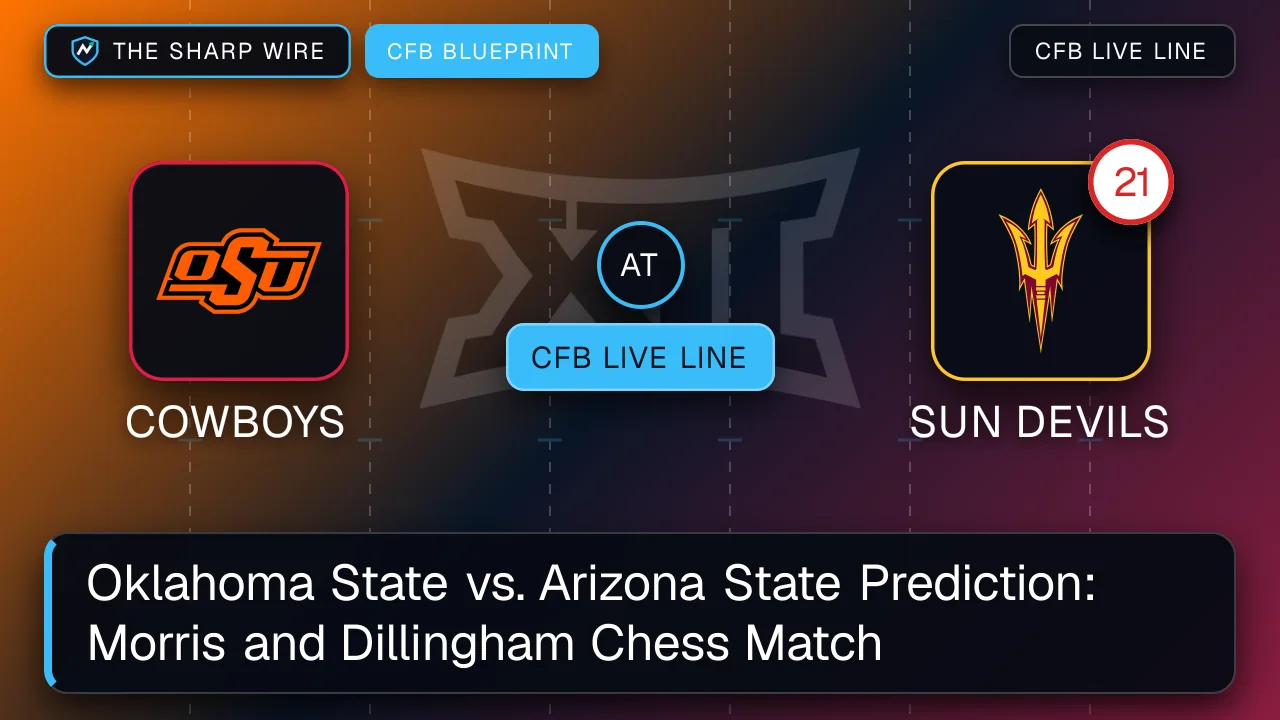
Oklahoma State vs. Arizona State Prediction: Morris and Dillingham Chess Match
Eric Morris and Kenny Dillingham face off in a Big 12 tactical battle where red-zone efficiency and a shifting 59.5-point total define the betting value.

- ▪The total has dropped from 62 to 59.5, indicating that sharp money expects a more disciplined, lower-scoring game than the opening number suggested.
- ▪The spread has moved off the key number of 3, meaning there is no inherent value in backing Oklahoma State or Arizona State at the current -2.5 price.
- ▪Kenny Dillingham's fourth-down aggression at home is a critical factor that could disrupt Eric Morris's offensive rhythm, making live-betting the best path to finding an edge.
The tactical chess match between Oklahoma State head coach Eric Morris and Arizona State head coach Kenny Dillingham hinges on a critical divergence in situational philosophy. While Morris seeks to leverage high-volume passing efficiency to sustain drives, Dillingham has cultivated a culture of fourth-down aggression that tests the resolve of opposing defensive coordinators at Mountain America Stadium. This clash of styles serves as the primary engine for a game that has seen significant market movement, forcing both staffs to prioritize red-zone execution over field-goal attempts to secure a win in this Big 12 contest.
The betting market has reacted sharply to the evolving dynamics of this matchup, with the total dropping from an opening of 62 to 59.5 as of November 18. Simultaneously, the spread has tightened from an opening of 3 points down to 2.5, signaling a heightened expectation for a one-score outcome. As Oklahoma State travels to face an Arizona State squad that thrives on home-field intensity, the focus shifts toward which quarterback—Drew Mestemaker or Cutter Boley—can better navigate the specific environmental variables of the Bermuda grass surface in Tempe.
The Morris-Dillingham Tactical Divide: Red Zone vs. Fourth Down
Eric Morris enters this matchup with an Oklahoma State offense that relies on the arm of Drew Mestemaker to dictate tempo. The Cowboys' ability to convert red-zone trips into touchdowns rather than settling for field goals will be the defining factor in their pursuit of a road victory. Morris must balance his aggressive play-calling with the discipline required to avoid empty possessions, as the Sun Devils' defense, anchored by Jalen Thompson’s team-leading 7 sacks, excels at forcing negative plays in high-leverage situations.
Conversely, Kenny Dillingham has established Arizona State as one of the most unpredictable teams in the Big 12 when facing fourth-down scenarios. By consistently choosing to extend drives rather than punting, Dillingham forces opponents to remain disciplined in their coverage shells for longer durations. This high-variance approach at Mountain America Stadium creates a unique pressure on the Oklahoma State defense, which must maintain its assignment integrity throughout the entire duration of every Sun Devils offensive series to prevent explosive plays.
Mestemaker’s Volume vs. Boley’s Efficiency
Drew Mestemaker has been the primary catalyst for the Oklahoma State offense, accumulating 3,239 passing yards and 30 touchdowns this season. His ability to distribute the ball to playmakers like Justin Bowick has allowed the Cowboys to maintain a high level of offensive production despite the rigors of the Big 12 schedule. However, the drop in the total from 62 to 59.5 suggests that the market anticipates a more methodical approach, potentially limiting the number of total possessions available for the Cowboys to exploit their passing volume.
Arizona State quarterback Cutter Boley offers a different profile, having recorded 1,360 passing yards with a 13:5 touchdown-to-interception ratio. While his volume is lower than Mestemaker's, Boley’s efficiency in managing the game allows the Sun Devils to control the clock and keep their defense fresh. The transition to the Bermuda grass at Mountain America Stadium, which typically plays slightly slower than the Hellas Matrix Turf in Stillwater, may further dampen the pace, favoring a game script that prioritizes ball security over pure vertical aggression.

Road Environment and Venue Physics in Tempe
The environmental shift from the 905-foot elevation of Stillwater to the 1,160-foot elevation in Tempe presents a subtle but measurable challenge for the Oklahoma State roster. The physical toll of playing on Bermuda grass can influence the speed of skill players and the effectiveness of pass-rushing lanes. The Cowboys must adjust their footing and timing to ensure that their offensive rhythm remains consistent despite the change in surface and altitude.
Special teams will serve as a hidden yardage factor in this sub-3-point spread, as field position often dictates the scoring ceiling in tightly contested games. Arizona State’s ability to pin opponents deep at Mountain America Stadium has been a hallmark of their home-field advantage this season. Oklahoma State’s special teams unit must be prepared to handle the unique bounce of the Bermuda grass, as any miscue in the kicking game could provide the Sun Devils with the short-field opportunities necessary to overcome a talent deficit.
Market Verdict: Why the Hook at 2.5 Demands Patience
The movement of the spread from 3 to 2.5 represents a critical inflection point for observers of this game. By crossing the key number of 3, the market has effectively entered a 'dead zone' where the value of the favorite is diminished, yet the underdog does not offer the insurance of a full field goal. This shift suggests that the market is increasingly confident in a narrow margin of victory, making the current pricing less attractive for those seeking to capture the full value of the closing line.
Given the current volatility, a patient approach is the most prudent strategy for those analyzing the game. Waiting for a live line that offers Oklahoma State at -1 or Arizona State at +3.5 would provide a significantly better risk-adjusted entry point. In a game projected to be decided by a single score, the difference between the current 2.5-point spread and a key number like 3 is substantial, justifying a wait-and-see stance until the live market provides a more favorable pricing opportunity.
Oklahoma State vs. Arizona State Prediction: Morris and Dillingham Chess Match
The market has spoken, with the total crashing from 62 down to 59.5, signaling a shift toward a more methodical, situational contest rather than the high-scoring track meet initially anticipated. This correction reflects a consensus that both coaching staffs will prioritize clock management and red-zone efficiency over explosive, high-variance plays.
With the spread hovering at -2.5, we have moved off the critical key number of 3, rendering the current pregame line efficient and devoid of immediate value. The move toward Arizona State suggests the market respects the home-field advantage at Mountain America Stadium, but the current price does not offer enough cushion to justify a pregame position.
We are monitoring this game for a live-betting entry. If the game flow dictates a defensive stalemate, we will look to buy the Under at a higher number or wait for the spread to touch 3 or higher to back the underdog. Patience is the primary strategy here given the lack of a key-number edge.
Frequently Asked Questions
Sharp Wire Market DeskWhat is the kickoff time for Oklahoma State vs. Arizona State?
The game kicks off at 10:15 PM ET on Saturday, November 21, 2026.
Why is the current spread considered efficient?
The spread has moved off the key number of 3, leaving no significant value for either side at the current -2.5 line.
What is the primary indicator for this matchup?
The total has dropped significantly from 62 to 59.5, suggesting the market anticipates a more defensive, situational game script. See our College Football Handicapping Guide for deeper market methodology.