































































ACC Futures Market Analysis Reveals Value Outside of Duke Blue Devils
As Duke faces efficiency questions, the ACC futures market offers significant value on surging programs like Virginia and North Carolina.
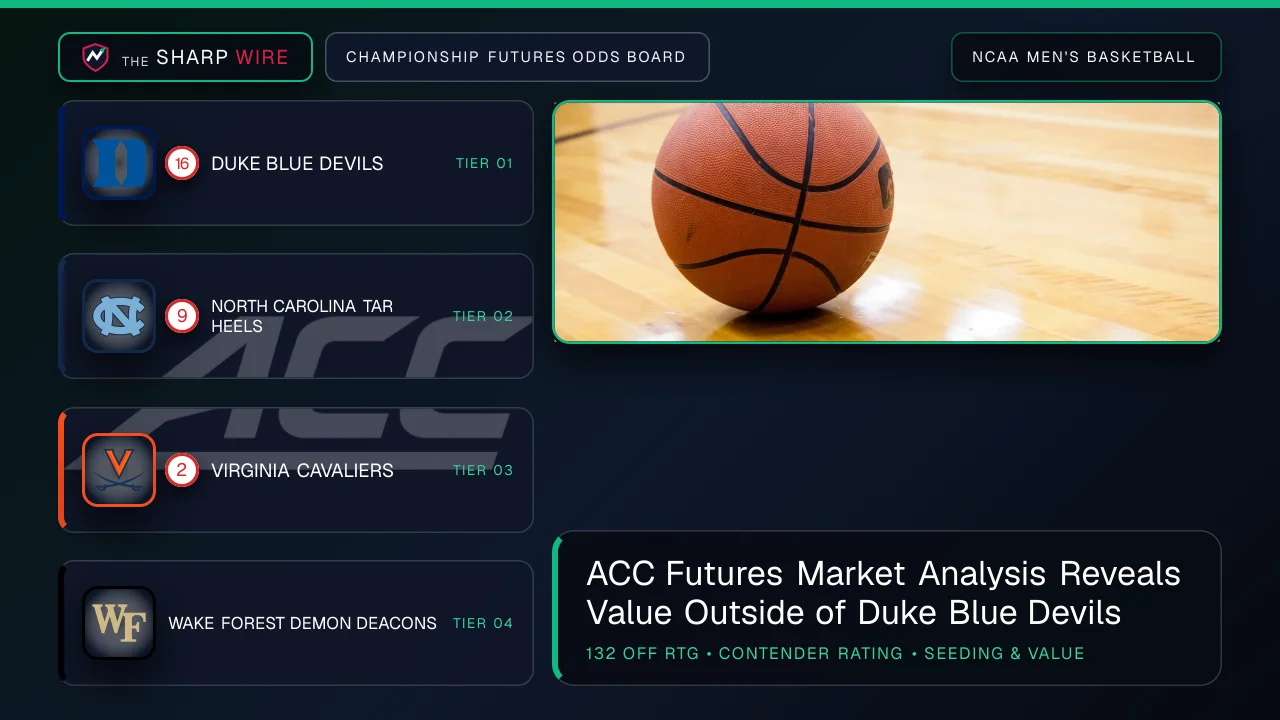
- ▪Public brand bias toward the Duke Blue Devils has created a value vacuum for the rest of the ACC top tier.
- ▪Virginia's shift to a high-tempo, high-efficiency offense makes them the primary value target in the conference futures market.
- ▪North Carolina's defensive modernization under Michael Malone provides a statistically sound basis for a long-shot portfolio position at +6000.
The Atlantic Coast Conference landscape is undergoing a profound tactical metamorphosis that the current futures market has yet to fully digest. While the public remains fixated on the traditional recruiting headlines emanating from Durham, the actual on-court efficiency data suggests a significant narrowing of the competitive gap between the established favorites and the surging programs in Charlottesville and Chapel Hill.
The 2026 season has exposed a disconnect between market pricing and performance metrics, as programs like Virginia and North Carolina have evolved their identities to align with modern high-tempo offensive requirements. For sharp observers, this creates a distinct opportunity to re-evaluate the championship hierarchy before the conference schedule begins to normalize the current statistical outliers.
Shifting Identity in the ACC Power Structure
Virginia has fundamentally pivoted away from the slow-paced, defensive-first reputation that defined the program for over a decade. Under head coach Ryan Odom, the Cavaliers have embraced a high-tempo offensive philosophy, currently operating at an adjusted tempo of 72.2 possessions per 40 minutes, which ranks 7th nationally. This stylistic evolution has transformed the team into an offensive juggernaut, scoring 92.4 points per game while maintaining a 59.6% effective field goal percentage. The shift is not merely cosmetic; it is a calculated tactical adjustment that leverages the versatility of the current roster to maximize scoring output.
At the heart of this transformation is Thijs De Ridder, whose offensive production has been a revelation. Averaging 18.4 points per game on 59.3% shooting from the floor, De Ridder provides the primary scoring punch that allows Virginia to maintain its aggressive pace without sacrificing efficiency. His ability to space the floor while also contributing 7.7 rebounds per game makes him the central pivot point for Odom’s system. As the Cavaliers continue to refine their defensive efficiency, currently allowing 96.7 points per 100 possessions, their ability to sustain this high-octane output will be the key indicator of their long-term title viability.
Conversely, North Carolina is undergoing a defensive modernization under the guidance of Michael Malone. The Tar Heels have prioritized defensive disruption, anchored by a disciplined scheme that has kept opponents to 66.7 points per game. While the transition has required a period of adjustment, the results are evident in their 5-1 record and their ability to control the tempo of the game through defensive stops. By focusing on limiting perimeter looks and forcing contested shots, North Carolina has successfully modernized its defensive identity, positioning itself as a formidable contender within the conference hierarchy.
Terrence Brown has emerged as the offensive catalyst for this new-look North Carolina squad, leading the team with 18.3 points per game. His scoring efficiency, combined with the team's rebounding prowess—anchored by Maximo Adams’ 7.2 rebounds per game—provides a balanced approach that contrasts sharply with the team’s historical reliance on pure transition scoring. As the Tar Heels continue to integrate these defensive improvements, their offensive floor remains high enough to compete with any program in the country, making their current market position a point of significant interest for those tracking efficiency trends.
 EFFICIENCY & STATISTICAL COMPARISON
| TEAM | REC | STANDING | PPG | ORTG | EFG% | 3PT% | AST/TO |
|---|---|---|---|---|---|---|---|
 #5Duke Blue Devils | 4-2 | 1st in ACC (T) | 86.0 (#70) | 118.1 (#70) | 51% | 28.0% | 1.4 |
 North Carolina Tar Heels | 5-1 | 1st in ACC (T) | 84.7 (#90) | 116.8 (#90) | 52.5% | 32.5% | 1.5 |
 #4Virginia Cavaliers | 7-0 | 1st in ACC (T) | 92.4 (#23) | 132 (#23) | 59.6% | 37.8% | 1.9 |
 Wake Forest Demon Deacons | 5-1 | 1st in ACC (T) | 79.3 (#172) | 116.4 (#172) | 51.4% | 29.9% | 1.3 |
Duke Market Over-Leverage and Efficiency Gaps
The Duke Blue Devils currently sit at +475 to win the championship, a price that appears heavily influenced by brand recognition and high-profile recruiting success rather than current on-court efficiency. Despite a 4-2 record, the Blue Devils have struggled to establish consistent dominance against top-tier competition. The recent commitment of international star Matija Lukic has dominated the media cycle, yet this recruiting victory does little to address the immediate efficiency gaps exposed in losses to Illinois and Michigan State. The market remains over-leveraged on the potential of the roster, ignoring the reality of their current performance metrics.
Statistically, Duke relies heavily on rim protection, averaging 7.0 blocks per game, which ranks tied for 10th nationally. While this provides a defensive safety net, it masks deeper issues with perimeter shooting and offensive spacing. The team is currently shooting 28.0% from three-point range, a figure that severely limits their ability to punish defenses that pack the paint. When opponents successfully negate the interior presence of Patrick Ngongba II, the Blue Devils have struggled to find consistent secondary scoring options, leading to an offensive efficiency that does not match their status as the market favorite.
The reliance on rim protection also creates a volatility in their defensive profile. While they are effective at forcing tough shots inside, their 3-point attempt rate of 44.9% suggests that they are susceptible to teams that can space the floor and force their big men to defend in space. This tactical vulnerability was exploited by Illinois and Michigan State, both of which were able to generate open perimeter looks that neutralized Duke's interior advantage. As the season progresses, the inability to consistently defend the perimeter will likely become a more pronounced issue against elite conference opponents.
Ultimately, the market pricing for Duke reflects a projection of future growth rather than a reflection of current standing. While the talent level is undeniably high, the gap between their current efficiency and the top-tier teams in the country is widening. For disciplined market participants, the current +475 price offers little value, especially when compared to the performance of teams that have demonstrated greater tactical flexibility and defensive consistency. The reliance on recruiting headlines to drive market sentiment is a classic indicator of an over-leveraged position that may face further correction as the season continues.
Why Beating the Closing Number Matters More Than Last Night's Final Score.
How Vegas oddsmakers hang opening numbers, why closing line value (CLV) is the best indicator of long-term winning play, and how to calculate the vig on any market.
Identifying Futures Value and No-Vig Pricing
When evaluating futures markets, the most effective approach involves stripping the hold—or 'vig'—from the posted odds to determine the true probability of success. In the current ACC futures market, the discrepancy between the implied probability of Duke’s +475 and the actual efficiency metrics of Virginia (+2800) and North Carolina (+6000) is stark. By applying a no-vig fair odds calculation, it becomes clear that the market has significantly undervalued the risk-adjusted potential of these two programs, creating a mispriced scenario that favors the challengers.
Virginia’s +2800 price point is particularly compelling given their 7-0 record and their top-tier offensive efficiency. The Cavaliers have demonstrated the ability to adapt to high-tempo basketball while maintaining a defensive standard that is sufficient for tournament play. When compared to the market favorite, the efficiency gap is negligible, yet the price difference is substantial. This suggests that the market is still pricing Virginia based on outdated perceptions of their 'Pack-Line' heritage rather than their current reality as a high-scoring, efficient offensive powerhouse.
North Carolina’s +6000 price represents an even greater potential for value. While their defensive modernization is a work in progress, the team has shown a consistent ability to win games through disciplined play and balanced scoring. With a 5-1 record and a clear path to improving their efficiency metrics as the season progresses, the Tar Heels are currently priced as a longshot rather than a legitimate contender. For those looking to construct a balanced futures portfolio, the current odds provide a significant buffer against the inherent volatility of tournament play, making them a logical addition.
The key to identifying value in these markets is to prioritize programs that have demonstrated a high floor in their efficiency metrics. Both Virginia and North Carolina have shown the ability to maintain high levels of performance even when their primary scoring options are neutralized. This tactical depth is essential for navigating the rigors of a conference season and, eventually, a tournament run. By focusing on these metrics rather than the noise of recruiting headlines, it is possible to identify positions that offer superior risk-adjusted returns in a market that remains overly focused on brand equity.
 ATLANTIC COAST CONFERENCE STANDINGS
| Seed / Team | REC | CONF | GB | HOME / AWAY | DIFF | TITLE ODDS | STREAK |
|---|---|---|---|---|---|---|---|
| 1.#4Virginia Cavaliers | 7-0 | 0-0 | 0.0 | 5-0 / 1-0 | +173 | W7 | |
2. Pittsburgh Panthers | 7-0 | 0-0 | 0.0 | 4-0 / 1-0 | +128 | W7 | |
3. SMU Mustangs | 6-0 | 0-0 | 0.5 | 6-0 / 0-0 | +148 | OTB | W6 |
4. Boston College Eagles | 6-0 | 0-0 | 0.5 | 4-0 / 1-0 | +107 | W6 | |
5. Notre Dame Fighting Irish | 6-1 | 0-0 | 1 | 3-0 / 0-0 | +100 | W2 | |
6. Virginia Tech Hokies | 6-1 | 0-0 | 1 | 4-0 / 0-0 | +96 | L1 | |
7. #17Miami Hurricanes | 5-1 | 0-0 | 1.5 | 5-0 / 0-0 | +195 | W5 | |
8. Florida State Seminoles | 5-1 | 0-0 | 1.5 | 4-1 / 0-0 | +120 | W3 | |
| 9.North Carolina Tar Heels | 5-1 | 0-0 | 1.5 | 5-1 / 0-0 | +108 | W2 | |
10. NC State Wolfpack | 5-1 | 0-0 | 1.5 | 4-0 / 0-0 | +90 | L1 | |
| 11.Wake Forest Demon Deacons | 5-1 | 0-0 | 1.5 | 5-0 / 0-1 | +86 | W4 | |
12. Georgia Tech Yellow Jackets | 5-1 | 0-0 | 1.5 | 5-1 / 0-0 | +55 | L1 | |
13. Stanford Cardinal | 5-1 | 0-0 | 1.5 | 5-0 / 0-1 | +54 | W2 | |
14. #23Louisville Cardinals | 3-1 | 0-0 | 2.5 | 3-0 / 0-1 | +58 | W1 | |
15. California Golden Bears | 5-2 | 0-0 | 2 | 5-1 / 0-0 | +93 | W3 | |
| 16.#5Duke Blue Devils | 4-2 | 0-0 | 2.5 | 3-1 / 0-0 | +115 | W1 | |
17. Syracuse Orange | 4-2 | 0-0 | 2.5 | 4-0 / 0-1 | +61 | W2 | |
18. Clemson Tigers | 4-2 | 0-0 | 2.5 | 4-1 / 0-0 | +46 | L1 |
Wake Forest and the Bubble Tier Outlook
Wake Forest occupies a fascinating position in the ACC as a bubble-tier program with the potential to disrupt the established hierarchy. Under Steve Forbes, the Demon Deacons have cultivated a disciplined identity that prioritizes efficiency over raw athleticism. With a 5-1 record, they have demonstrated the ability to compete with high-level opponents by controlling the pace and executing their offensive sets with precision. Their current futures pricing of +50000 reflects their status as a peripheral contender, yet their efficiency metrics suggest they are more competitive than the market implies.
Kevair Kennedy has been the standout performer for Wake Forest, averaging 17.2 points per game on 50.8% shooting. His ability to create his own shot and distribute the ball effectively—averaging 3.7 assists per game—makes him the engine of the offense. Kennedy’s efficiency is a testament to Forbes’ tactical approach, which emphasizes high-percentage shots and disciplined ball movement. While the team lacks the sheer volume of scoring seen in programs like Virginia, their ability to maintain a high level of efficiency makes them a dangerous opponent for any team in the conference.
While Wake Forest remains a longshot in the futures market, their current performance indicates that they are a program on the rise. As they continue to navigate the ACC schedule, their ability to remain efficient under pressure will be the defining factor of their season. For those monitoring the bubble tier of the conference, Wake Forest represents a program that is consistently outperforming its market expectations, making them a team to watch as the season approaches its critical mid-point. Their current trajectory suggests that they are well-positioned to challenge for a higher seed and potentially make a deep run in the conference tournament.
ACC Futures Market Analysis Reveals Value Outside of Duke Blue Devils
The current ACC futures market remains heavily skewed by public perception and recruiting headlines surrounding the Duke Blue Devils, who hold the shortest odds at +475. While Duke maintains elite rim protection, the efficiency gap between the conference favorite and the rest of the top tier has narrowed significantly.
Virginia has successfully pivoted to a high-tempo offensive identity under Ryan Odom, currently ranking 7th nationally in adjusted tempo and boasting a potent 132 ORTG. At +2800, the Cavaliers represent a significant mispricing relative to their 7-0 start and offensive production.
Similarly, the North Carolina Tar Heels, priced at +6000, are undergoing a defensive modernization that is not yet fully reflected in their championship odds. With Terrence Brown anchoring the perimeter, the Tar Heels provide a high-ceiling portfolio option for those looking to fade the public's over-leverage on the Duke brand.
Subscribe to Our Free Daily Betting Newsletter.
See how lines are moving before kickoff and tipoff—verified opener-to-current line movement, key-number spread alerts, and confirmed starter injuries delivered free to your inbox.
Frequently Asked Questions
Sharp Wire Market DeskWhen is the best time to enter a futures position on the ACC winner?
Futures markets are most efficient when public betting volume is low; entering positions before major conference-slate matchups allows for better price discovery.
How does Virginia's new offensive style impact their long-term viability?
Virginia's transition to a high-tempo offense under Ryan Odom has increased their offensive ceiling, making them more competitive in high-scoring tournament environments.
Are there any injury concerns for the top ACC contenders?
As of November 24, 2026, Duke, North Carolina, Virginia, and Wake Forest report clean impact availability with no Tier 1 or Tier 2 starter cluster penalties.