













































































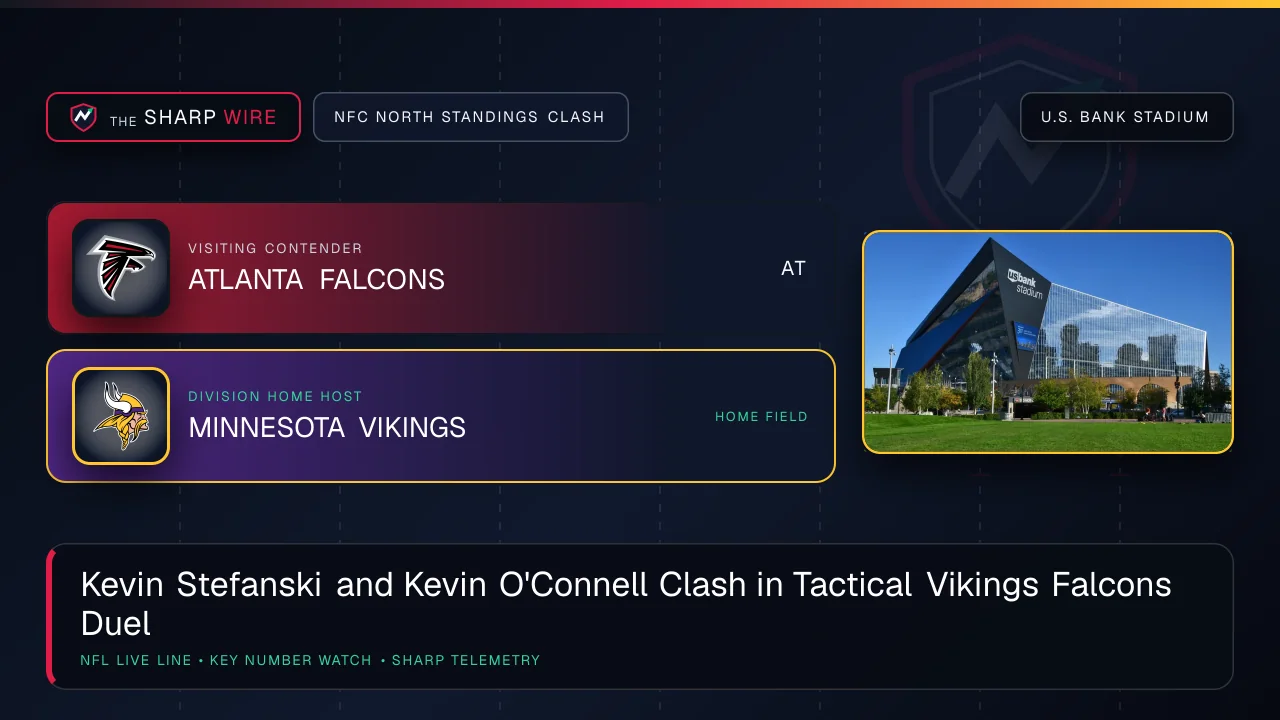
Kevin Stefanski and Kevin O'Connell Clash in Tactical Vikings Falcons Duel
Kevin Stefanski and Kevin O'Connell face off in a critical situational battle where red-zone efficiency and fourth-down aggression will dictate the outcome at U.S. Bank Stadium.

- ▪The Vikings' defense, despite recent struggles, remains the most efficient unit in this matchup, allowing only 16.1 points per game.
- ▪The Falcons benefit from a mini-bye rest advantage, but must overcome a significant turnover deficit to keep this game within the seven-point spread.
- ▪With the total set at 42, the market is signaling a expectation for defensive-minded scoring, consistent with the controlled environment at U.S. Bank Stadium.
Kevin Stefanski brings his Atlanta Falcons into U.S. Bank Stadium looking to disrupt the rhythm of Kevin O'Connell’s Minnesota Vikings. This matchup represents a critical juncture for both franchises, as the Falcons attempt to leverage their recent preparation time against a Vikings squad looking to rebound from a loss in Mexico City. The tactical tension centers on how Stefanski manages Michael Penix Jr. against a Vikings defense that remains a disciplined unit under O'Connell’s guidance.
For Minnesota, the focus shifts to Kirk Cousins’ ability to stabilize an offense that has leaned heavily on its defensive identity throughout the 2026 campaign. With the spread holding steady at seven points, the game serves as a litmus test for both coaching staffs to prove their respective schemes can sustain drives in high-leverage situations. The outcome hinges on which team can dictate the pace, forcing the opponent to deviate from their preferred offensive rhythm in the face of persistent defensive pressure.
Coaching Chess Match and Situational Play-Calling
Kevin Stefanski’s offensive philosophy in Atlanta has been defined by a commitment to the ground game, utilizing Bijan Robinson to anchor a rushing attack that averages 4.8 yards per attempt, currently tied for third in the NFL. By leaning on this efficiency, Stefanski aims to control the clock and keep the Minnesota pass rush, led by Andrew Van Ginkel, from pinning their ears back against Michael Penix Jr. The challenge for the Falcons is converting that methodical yardage into sustained drives, as their 20.1 points per game average suggests a struggle to finish sequences that start with promise.
Conversely, Kevin O'Connell’s approach with the Vikings relies on Kirk Cousins’ veteran command to navigate a complex set of pass-heavy concepts, even as the team deals with the absence of key targets like Jordan Addison. O'Connell must find a way to re-establish the offensive identity that saw the Vikings start the season with defensive dominance, as the team looks to move past a recent 10-35 defeat. The tactical battle between Stefanski’s ball-control preference and O'Connell’s explosive passing vision will likely determine which team dictates the tempo on the fast track of U.S. Bank Stadium.
Red Zone Efficiency and Third Down Battlegrounds
The battle inside the 20-yard line remains the most significant variable for both teams, as red-zone efficiency consistently dictates the difference between a cover and a loss on a seven-point spread. The Vikings currently allow the fewest points per game in the NFL at 16, a testament to their defensive red-zone discipline, while the Falcons have struggled to maintain consistency, ranking 23rd in overall scoring. The efficiency on third down serves as the primary engine for these scoring drives, with the Vikings’ ability to convert critical downs essential for sustaining their offensive rhythm.
Why Beating the Closing Number Matters More Than Last Night's Final Score.
How Vegas oddsmakers hang opening numbers, why closing line value (CLV) is the best indicator of long-term winning play, and how to calculate the vig on any market.
Atlanta’s reliance on the ground game often leads them into tight red-zone windows, where the lack of vertical threats, exacerbated by injuries, can stall progress. For Minnesota, the defensive strategy under O'Connell emphasizes forcing opponents into long-yardage situations, effectively neutralizing the run-heavy schemes that Stefanski prefers. If the Vikings can force the Falcons into third-and-long, the defensive front, which has recorded 8.5 sacks from Andrew Van Ginkel alone, will look to capitalize on the turnover-prone nature of the Atlanta passing attack.
 Falcons34.43%
 Vikings36.96%Falcons54.84%Vikings45.83%Falcons6.9 YPAVikings6.4 YPAFalcons-10Vikings6
Special Teams and Field Position Dynamics
Field position management will be paramount in a contest that sits squarely on the key number of seven, as both coaches recognize that every possession matters in a game with a total of 42. The Falcons have the luxury of fresh legs to manage the logistics of a road game in a dome environment, where the absence of wind allows for precise special teams execution. Stefanski’s willingness to be aggressive on fourth down will likely be tested if his offense finds itself in manageable distance, as the margin for error remains razor-thin against a Vikings defense that thrives on creating high-pressure moments.
Market participants have kept the spread at seven, reflecting a disciplined consensus that the Vikings’ home-field advantage at U.S. Bank Stadium is balanced by the Falcons’ rest and tactical adjustments. The key for observers is to wait for potential live-betting opportunities if the game shifts away from this key number, as the current pricing suggests a tightly contested battle where neither side holds a significant statistical edge. Discipline in the market is just as critical as the coaching decisions on the field, as both teams look to secure a vital win in their respective division standings.
Kevin Stefanski and Kevin O'Connell Clash in Tactical Vikings Falcons Duel
The Minnesota Vikings enter this matchup as a seven-point favorite, a number that reflects the market's respect for the Vikings' defensive efficiency despite their recent loss. With the spread holding steady at the opening seven, we are looking at an efficient market equilibrium that leaves little value on the current side.
The tactical battle between Kevin Stefanski and Kevin O'Connell will likely be decided by red-zone conversion rates and third-down sustainability. The Atlanta Falcons, coming off a rest period, have a slight edge in injury attrition, but the Vikings' ability to control the clock remains the primary factor. Disciplined bettors should avoid laying the seven and instead monitor live-betting pivots if the Vikings' offense stalls early.
Why Crossing Both 3 and 7 Is the Only Way Pros Play NFL Teasers.
Nearly a quarter of all NFL games finish on a 3-point or 7-point margin. Break down push rates, what a half-point is actually worth, and which spreads qualify for a Wong teaser.
Frequently Asked Questions
Sharp Wire Market DeskWhen is the Atlanta Falcons vs. Minnesota Vikings game?
The game is scheduled for Sunday, November 29, 2026, at 1:00 PM ET.
What is the current status of the Vikings' secondary?
The Minnesota Vikings are currently without starting cornerback Isaiah Rodgers due to a quadriceps injury, with an estimated return date of November 29.
How does the U.S. Bank Stadium environment affect the game?
U.S. Bank Stadium is a climate-controlled dome, which eliminates wind and weather variables, favoring a consistent passing game for both Kirk Cousins and Michael Penix Jr.